


The bitcoin-to-gold ratio in 2025 experienced one of the most significant declines in recorded history, falling by approximately 50%. If in December 2024 one bitcoin could buy about 40 troy ounces of gold, by the end of 2025 this figure had decreased to roughly 20 ounces. In fact, gold not only outpaced bitcoin in performance but confidently reclaimed its status as the primary wealth preservation tool in a world of global uncertainty.
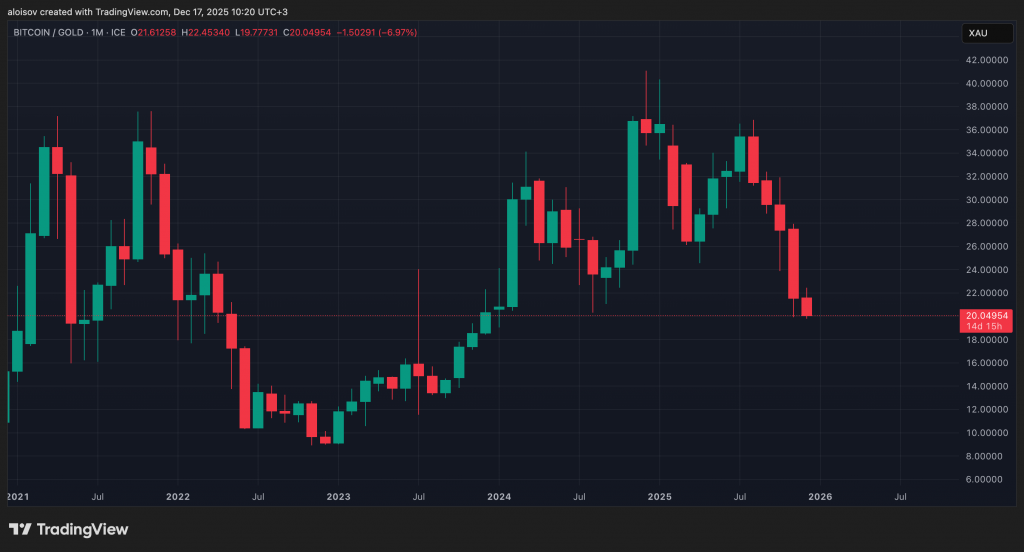
1-month chart BTC/XAU. Source: ICE
2025 was truly a triumphant year for gold. Since the beginning of the year, its price rose by about 63%, and in the fourth quarter it confidently surpassed the $4,000 per ounce mark. Importantly, this growth occurred not under a loose monetary policy, as often in the past, but amid tight financial conditions. U.S. interest rates remained high for most of the year, with the first Fed rate cut occurring only in September. Historically, such an environment would pressure non-yielding assets, yet in 2025 gold behaved differently, indicating a deep structural shift in demand patterns.
Central banks played a key role in this growth. During the first ten months of the year, they purchased 254 tonnes of gold, with the National Bank of Poland becoming the largest buyer, increasing its reserves by 83 tonnes. At the same time, trends in ETFs changed dramatically. While in 2023 the market saw steady outflows from gold funds, in 2025 the situation reversed completely. In the first half of the year, assets managed by global gold ETFs increased by 397 tonnes, reaching a record 3,932 tonnes by November.
Notably, this capital inflow occurred despite relatively high real bond yields. In Q2 2025, real yields in developed markets averaged around 1.8%, yet gold appreciated by 23% over the same period. This indicates a break in the classic inverse relationship between bond yields and gold prices. Investors increasingly viewed gold not just as an inflation hedge but as a universal trust asset in a world where traditional macroeconomic relationships are weakening.
Another factor was overall market instability. The VIX volatility index averaged 18.2 points in 2025 versus 14.3 the previous year. Geopolitical risk indices rose by roughly 34% year-over-year. Against this backdrop, gold’s correlation with equities turned negative, and gold’s beta to stocks contracted to -0.12 — the lowest level since 2008. This confirmed that gold had once again become a sought-after hedging instrument and long-term store of value.
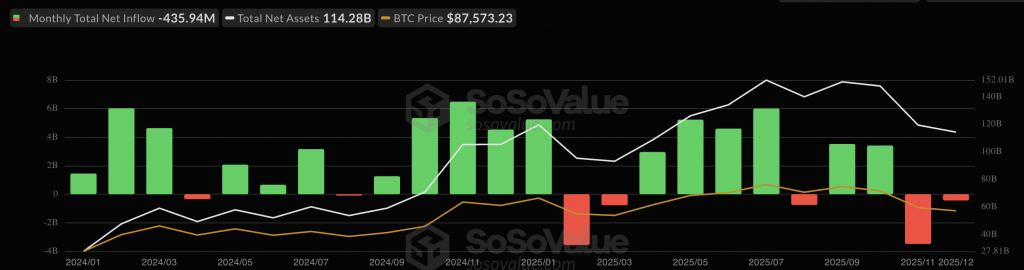
1-month chart of capital inflow into spot bitcoin ETFs. Source: SoSoValue
Amid this success, bitcoin looked relatively weaker. In absolute terms, the first cryptocurrency showed decent performance, reaching six-figure values during the year, supported by the launch and growth of spot bitcoin ETFs. However, in the second half of the year, demand for bitcoin began to weaken. At the start of 2025, assets managed by spot bitcoin ETFs rose from $120 billion in January to a peak of around $152 billion in July, followed by a sustained capital outflow. By year-end, assets had fallen to roughly $112 billion, a net outflow of about $40 billion over five months.
This process was accompanied by changes in on-chain data. According to Glassnode, in October long-term holders sold approximately 300,000 bitcoins worth about $33 billion. This was the most aggressive wave of sales since December 2024. As a result, total reserves of long-term investors declined from 14.8 million BTC in July to roughly 14.3 million BTC at the time of publication. Essentially, some large players preferred to lock in profits rather than continue holding the asset amid heightened macroeconomic uncertainty.

High bond yields for much of 2025 also weighed against bitcoin. For institutional investors, holding a highly volatile asset with no fixed income appeared less attractive compared to reliable instruments with predictable returns. Meanwhile, bitcoin’s correlation with the stock market remained relatively high, reducing its value as a safe-haven asset. Gold, conversely, was increasingly used for portfolio reserve and insurance purposes.
Together, these factors clearly illustrate how the macroeconomic environment affects the relative attractiveness of different saving instruments. In 2025, gold adapted to the high-rate environment thanks to substantial institutional demand and central bank activity. Bitcoin, on the other hand, faced pressure due to profit-taking and temporarily reduced interest from large capital.
From a historical pattern perspective, the 50% decline in the BTC-to-gold ratio resembles periods in 2011-2012 and 2018, when investors actively reallocated capital between risky and defensive assets depending on the economic cycle phase. However, the current situation is largely unique. The last time gold showed such confident growth under high interest rates was during Paul Volcker’s era in the early 1980s.
Looking through the lens of algorithmic and machine data analysis, the current outflow from bitcoin ETFs may indicate deeper shifts in investor behavior. Older generations of investors are returning to time-tested instruments, while younger market participants temporarily reduce risk amid geopolitical and economic uncertainty. The question remains whether this is a long-term shift in priorities or just another rotation of assets, after which the balance between gold and digital assets may start to change again.
All content provided on this website (https://wildinwest.com/) -including attachments, links, or referenced materials — is for informative and entertainment purposes only and should not be considered as financial advice. Third-party materials remain the property of their respective owners.