


China continues to methodically promote blockchain — but in its own way: without hype, without crypto speculation, and with a strict focus on the real economy. This time, the focus is on the banking sector and lending, especially for small and medium-sized businesses that traditionally face limited access to financing.
Recent recommendations issued by the State Taxation Administration of China together with the National Financial Regulatory Administration of China set a clear direction: banks and public institutions are encouraged to actively adopt blockchain and privacy-enhancing technologies for data exchange. Not in theory, but in concrete processes — primarily to improve credit assessment and accelerate decision-making.
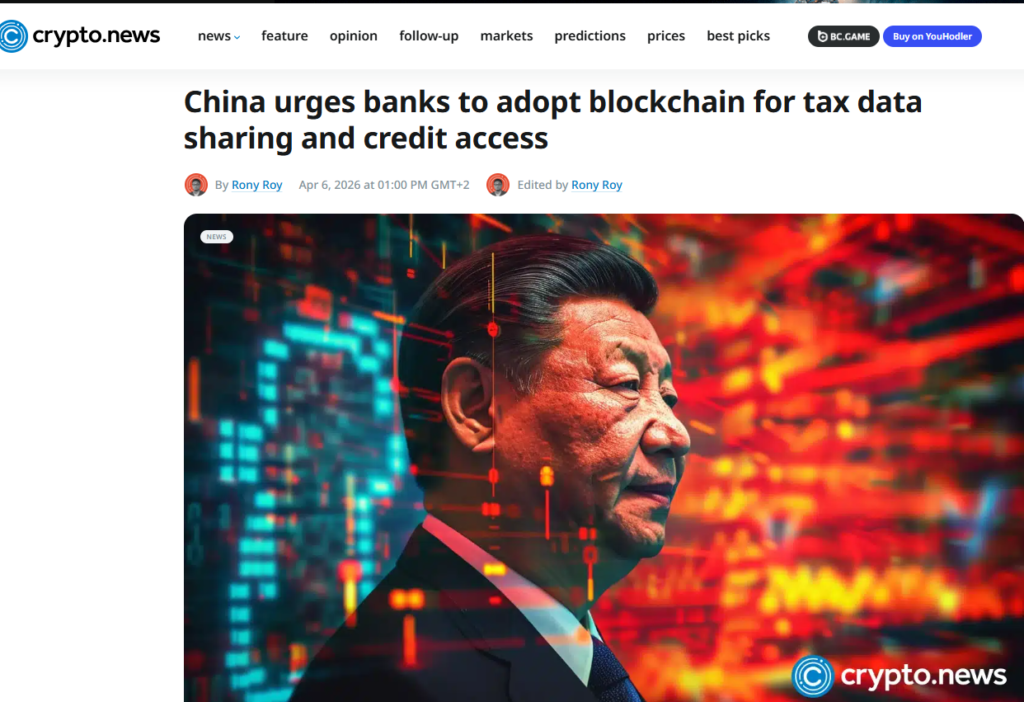
China urges banks to adopt blockchain for tax data sharing and credit access
The idea is quite pragmatic. Today, banks often face a situation where small businesses simply lack sufficient credit history. As a result, even viable companies cannot access financing. China proposes replacing the traditional “no history — no credit” model with a more modern approach, where data becomes the source of trust. Tax payments, turnover, operational activity — all of this can be used to assess creditworthiness.
This is where blockchain becomes not a buzzword, but a tool. It enables the creation of a secure environment where data can be shared between tax authorities and banks without the risk of tampering or leakage. Add privacy-preserving computation technologies, and you get a system where data can be used without being exposed in raw form. For the state, this means control and transparency; for businesses, access to financing; for banks, reduced risk.
This move is not isolated — it fits into China’s broader strategy to build a national data infrastructure. Following decisions made at the Third Plenary Session of the 20th CPC Central Committee, data is officially recognized as a full-fledged factor of production alongside labor and capital. That means it should not just be stored, but actively circulated — securely, controllably, and at scale.
The scale is significant. According to official data, China generated over 41 zettabytes of data in 2024 — a growth of about 25% year over year. The forecast for 2025 exceeds 50 zettabytes. These are volumes that cannot be effectively utilized without systemic infrastructure. This is where blockchain and privacy technologies become not experimental, but essential.
By the end of 2024, more than 400,000 companies in China were involved in data processing in one way or another. This creates an entire ecosystem that requires trusted “data spaces” — environments where information can circulate securely between participants. In this model, blockchain acts as a “trust registry,” recording transactions, access rights, and change history.
The economic dimension is also important. Estimates suggest that projects related to this initiative could attract around 400 billion yuan annually, with total investments over the next five years reaching approximately 2 trillion yuan. This is no longer just a tech initiative — it is a full-scale investment cycle impacting banking, IT, and the broader data economy.
For banks, the practical effect is clear. With access to secure tax data in near real time, they can better assess the condition of businesses. This reduces the number of “blind” loans, automates scoring, and speeds up lending decisions. In essence, a “data-as-collateral” model is emerging, where a company’s digital footprint becomes its financial reputation.
For small businesses, this could be a turning point. What once required a long track record and complex verification can now be resolved faster and more cheaply. For the economy as a whole, it is a way to unlock significant growth potential that was previously constrained by financial system limitations.
It is important to understand the key distinction of the Chinese approach. Unlike many other markets where blockchain has long been associated primarily with cryptocurrencies, China deliberately separates these directions. Crypto speculation remains tightly controlled, while blockchain technology is активно integrated into public and financial systems.
The result is an interesting model: blockchain without crypto hype, but with real-world application and scale. And if this system works as intended, it could not only transform lending within China but also set a new standard for how governments manage data in the economy.
All content provided on this website (https://wildinwest.com/) -including attachments, links, or referenced materials — is for informative and entertainment purposes only and should not be considered as financial advice. Third-party materials remain the property of their respective owners.