

Last night, the cryptocurrency market experienced a significant upward movement. Bitcoin was “pumped” to nearly $72,000 within a short period, marking one of the most noticeable price spikes in recent weeks. Despite the volatility that typically accompanies such moves, the cryptocurrency market as a whole has shown unexpected resilience. Against the backdrop of geopolitical tension and instability in traditional financial markets, digital assets are performing much stronger than many analysts had anticipated.
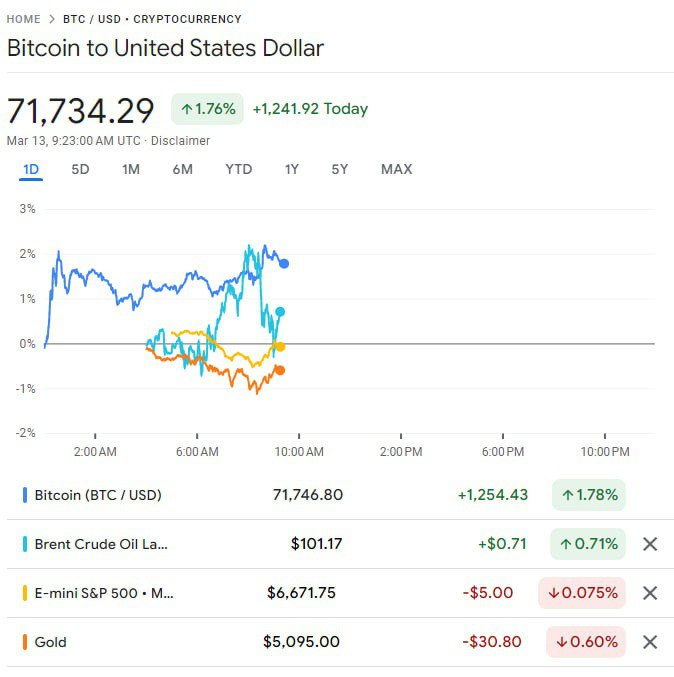
Periods of global uncertainty are usually accompanied by mass investor flight to traditional safe-haven assets. Historically, these have included gold, government bonds of developed countries, and sometimes the US dollar. However, in recent years, Bitcoin has gradually begun to claim a role as an alternative “capital haven.” While this status remains debated among economists, recent market movements are prompting many investors to reconsider this possibility.
One actively discussed explanation for the current surge is the rumored shift of capital from gold to Bitcoin amid heightened tensions in the Middle East. During crises, investors in the region traditionally seek to preserve capital in the most liquid and mobile form possible. Gold has long been considered a universal store of value, but physical metal comes with obvious limitations. It must be stored, transported, and protected, and moving large amounts quickly can be a complex task.
In this context, Bitcoin appears to be a more convenient tool. The digital asset can be transferred anywhere in the world in just a few minutes, using only internet access and a crypto wallet. For large amounts of capital, this becomes a major advantage. Essentially, having access to private keys allows management of significant funds without the need to transport physical assets.
Some analysts note that this logic is increasingly being applied by investors in regions with high political and economic instability. In this case, Bitcoin is seen less as a speculative instrument and more as a means of preserving and transferring capital. This is especially relevant when there is a risk of banking restrictions, currency controls, or limited access to the international financial system.
Another factor supporting the market is growing institutional interest. In recent years, large funds, investment companies, and financial institutions have gradually increased their presence in the crypto market. The emergence of Bitcoin-focused exchange-traded funds, the development of digital asset custody infrastructure, and clearer regulatory frameworks have made the market significantly more accessible to major players.
All of this creates additional demand for Bitcoin, which, combined with the coin’s limited supply, periodically leads to sharp price movements. When a large buyer or multiple large orders enter the market, liquidity can quickly tighten, causing so-called “short squeezes” and rapid price surges.
At the same time, some experts caution against taking the rumors of a mass capital shift from gold to Bitcoin at face value. Such processes are difficult to verify directly, as most large transactions occur off public markets. Nevertheless, indirect indicators, such as increased trading volumes, higher activity in large wallets, and sharp price moves during periods of geopolitical tension, fuel these discussions.
In any case, the current dynamics show that the cryptocurrency market is becoming increasingly sensitive to global events. Whereas Bitcoin previously reacted more to internal industry factors — regulation news, hacks, or technological updates — its price is now increasingly influenced by macroeconomics, politics, and international conflicts.
The key question for the market now is whether Bitcoin can hold above critical psychological levels, or if the nighttime surge will prove to be just a short-term liquidity spike. The crypto market is known for its volatility, and sharp upward movements are often followed by equally swift corrections.
Nevertheless, the very fact that Bitcoin demonstrates resilience and can rise amid global instability strengthens investors’ interest in cryptocurrencies as a new asset class. The more frequently such situations occur, the more entrenched the perception becomes that digital assets are gradually taking their place alongside traditional capital preservation instruments.
All content provided on this website (https://wildinwest.com/) -including attachments, links, or referenced materials — is for informative and entertainment purposes only and should not be considered as financial advice. Third-party materials remain the property of their respective owners.