

An expert predicted the “death of Bitcoin” due to miners switching to AI. The current transformation of the energy landscape of cryptocurrency mining may have an unprecedented impact on the Bitcoin network.
According to a recent statement by trader Ran Neuner, AI hosting today brings Bitcoin miners almost eight times more revenue than traditional mining. This difference is so significant that, according to the expert, it is “killing” the Bitcoin network, threatening its long-term sustainability.

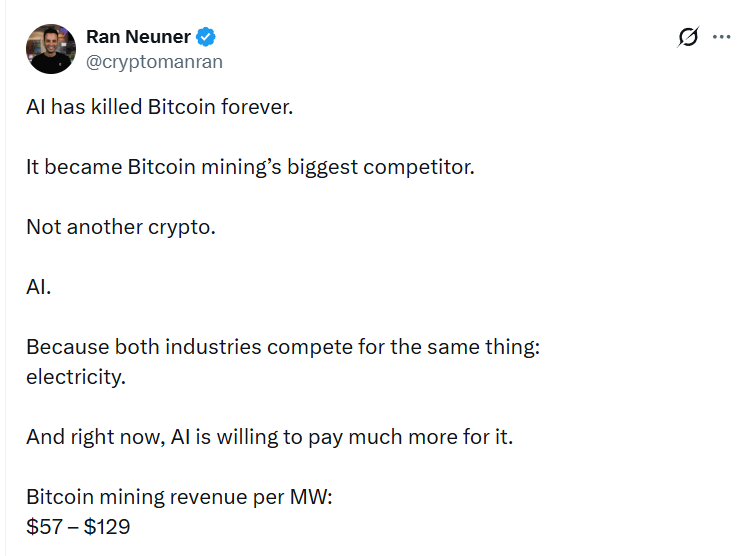
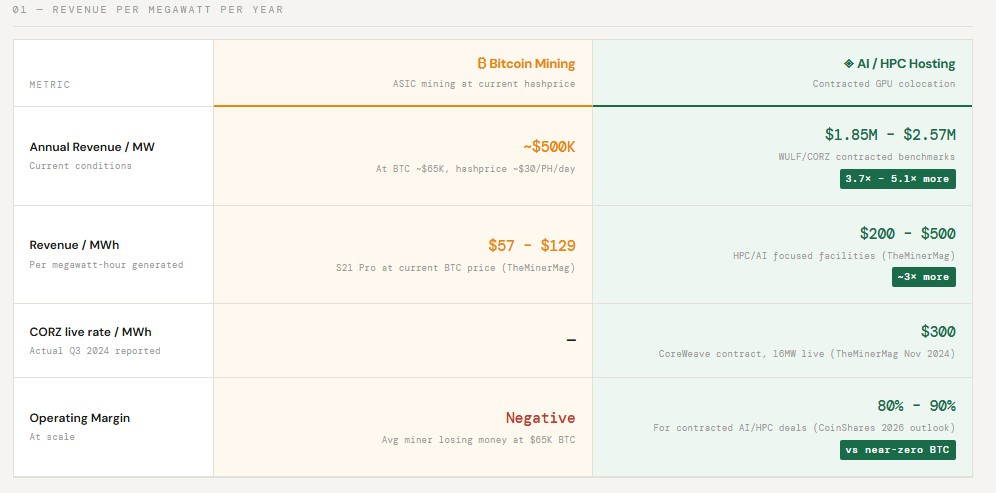
Neuner explains that both industries — Bitcoin mining and AI infrastructure — compete for the same energy resources. However, AI companies are willing to pay significantly more for electricity. Digital gold miners today earn approximately $57–129 per megawatt, while neural network data centers bring $200–500 for the same amount of energy consumed.
This imbalance creates a real threat to blockchain functioning: if miners disconnect, the hash rate — the main network security indicator — falls. Already, a 14.5% decline in hash rate from the October peak has been observed. With fewer miners, the probability of a 51% attack increases, putting the blockchain’s resilience against potential attackers at risk.
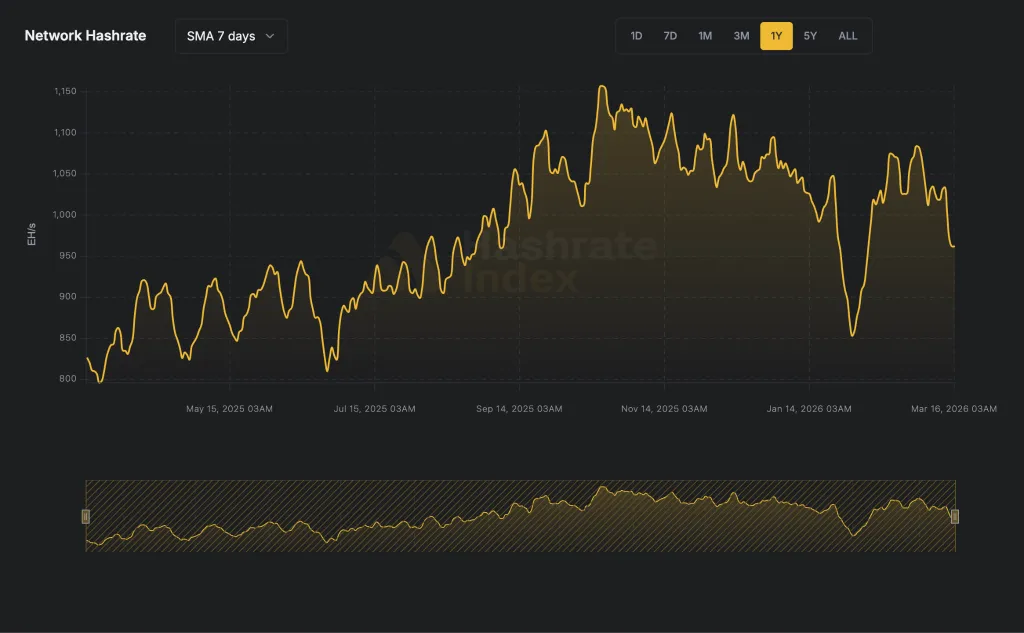
Bitcoin hash rate. Source: Hashrate Index
Corporate Examples of Switching to AI
Neuner provides several illustrative corporate sector examples showing the growing trend:
- Core Scientific received a $500 million loan from Morgan Stanley to build AI data centers.
- MARA Holdings notified the SEC of plans to sell part of its Bitcoin reserve to redirect funds toward AI infrastructure.
- Hut 8 signed a $7 billion agreement with Google to build AI infrastructure.
- Cipher Mining deliberately reduced its hash rate, redirecting capacity to neural network services.
- Bitmain co-founder Jihan Wu completely left mining for AI.
“If I were a miner, the choice would be obvious. That’s why more participants are leaving the network,” Neuner noted, emphasizing the direct economic motivation for leaving.
Opposing Views
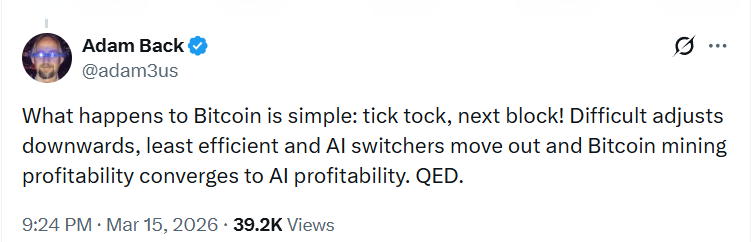
Not all experts agree with the pessimistic forecast. Bitcoin industry pioneer and Blockstream CEO Adam Back claims that mining difficulty adjustment will automatically compensate for the exit of less efficient players. “Tick-tock, next block! Difficulty falls, those who switched to AI leave, and mining profitability aligns with AI profitability,” he explained.

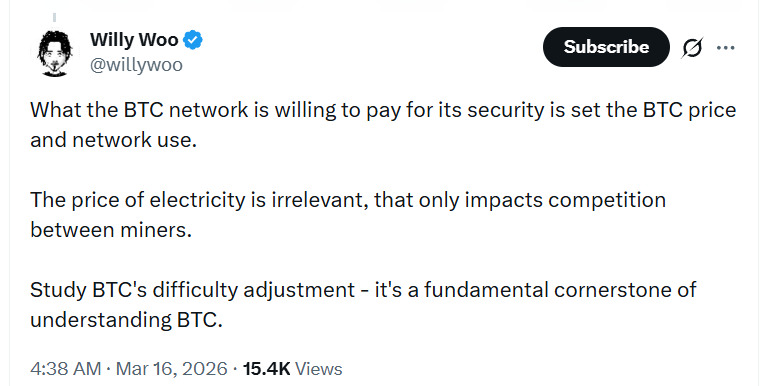
Analyst Willy Woo added that in this context, electricity price is not a decisive factor for network stability: it only affects competition among miners. “How much the Bitcoin network is willing to pay for its security is determined by BTC price and blockchain usage. […] Study Bitcoin’s difficulty adjustment mechanism — it is a fundamental cornerstone for understanding BTC,” he emphasized.
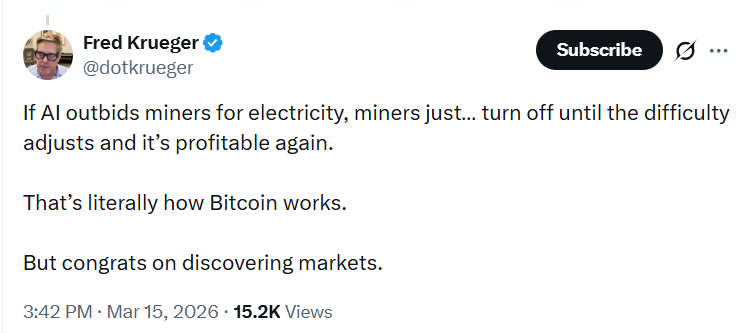
Investor Fred Krueger also explained that miners disconnecting under more profitable AI offers is a normal cycle: network difficulty will gradually decrease, and mining will return to profitability.
Miners’ Role in the Energy Ecosystem and AI
ESG specialist Daniel Batten noted that miners’ shift to AI is not necessarily a total loss for Bitcoin. Miners can utilize underused energy, balance power grids, and efficiently operate outdated equipment on cheap electricity. Moreover, AI infrastructure development can indirectly support energy systems, creating new incentives for distributed energy consumption, which in the long term may also benefit the crypto industry.

However, the current economic model places Bitcoin in a difficult situation: digital gold competes with AI for limited energy resources. Experts agree that the only way to retain miners is through Bitcoin price growth and maintaining long-term mining profitability. “I hope Bitcoin shows one green candle. Maybe because of war, maybe because of regulation,” Neuner concluded, leaving the future of the first cryptocurrency uncertain.
Conclusion
The conflict between Bitcoin miners and the AI industry illustrates a broader trend: the value of electricity as a resource and its potential applications determine strategic decisions of market participants. In the coming years, competition between digital gold and high-performance AI systems is likely to intensify, which may become one of the key factors affecting Bitcoin’s dynamics, hash rate, and network security.
All content provided on this website (https://wildinwest.com/) -including attachments, links, or referenced materials — is for informative and entertainment purposes only and should not be considered as financial advice. Third-party materials remain the property of their respective owners.