


The total crypto market capitalization has declined by roughly 20% since the start of the year — and this no longer looks like an ordinary correction that investors have grown used to over recent cycles. Instead, the market appears to be entering a phase of prolonged pressure, where sell-offs are becoming not an emotional reaction, but a new normal.
Bitcoin continues to slide: this morning the price dropped to $70,000. On Bitstamp and several smaller exchanges, it even briefly fell below that level. This marks another low since early November 2024 — the moment Donald Trump won the presidential election, when markets were still fueled by expectations of a fresh political and financial impulse.

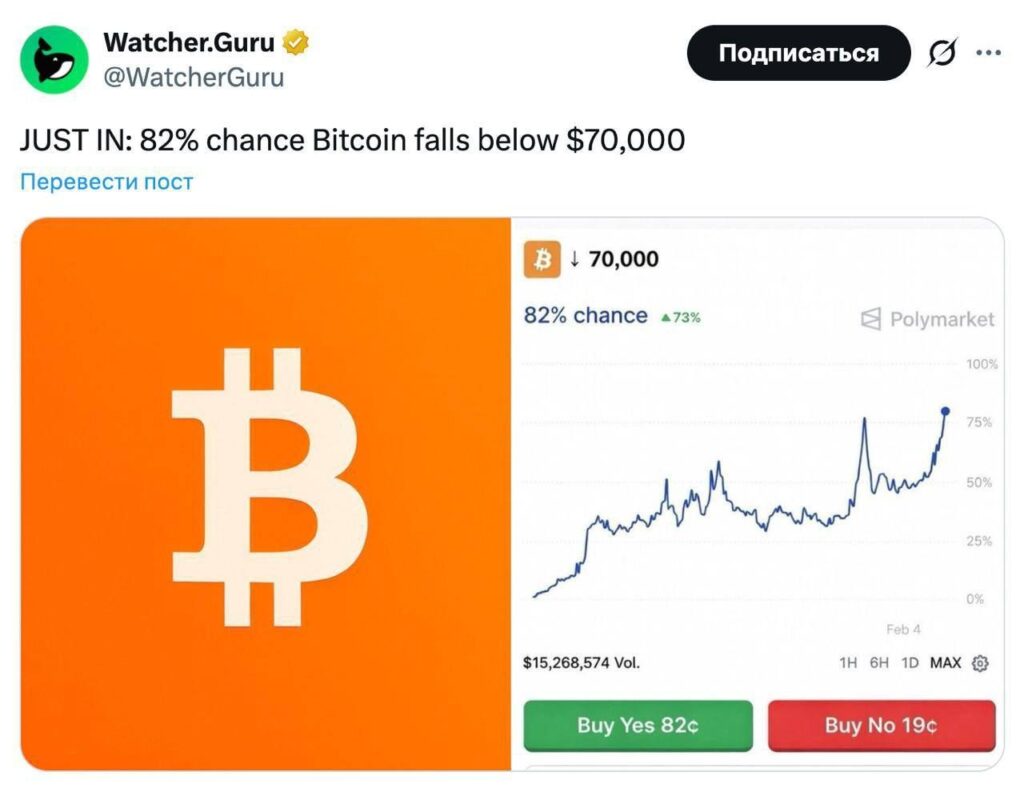
That impulse has now completely faded. Instead of post-election optimism, the market is facing exhaustion and liquidations.
Ethereum has retreated back to May 2025 levels, effectively wiping out all gains from recent months. Solana has hit a two-year low, confirming that the pressure is spreading beyond BTC and across the entire high-risk altcoin sector. The market is moving downward in sync: both major leaders and second-tier projects are falling, because in phases like this investors don’t choose the “best technologies” — they simply reduce risk exposure.
This is hitting the derivatives market especially hard. According to Coinglass, roughly $700 million in long positions were liquidated over the past 24 hours. Nearly 200,000 traders faced forced closures. The biggest losses came from those who continued betting on BTC, ETH, and SOL, hoping for a rebound.
But the problem is that liquidations themselves become fuel for further decline: positions are closed automatically, selling pressure increases, prices drop even lower — triggering the next wave of margin calls. It’s a classic domino effect, and in crypto it works particularly brutally due to high leverage and 24/7 trading.
The latest weekly CryptoQuant report describes the current weakness as structural rather than cyclical. This is a crucial distinction. A cyclical downturn is a temporary pause within a bull market. Structural weakness means the foundation of demand has changed: fewer buyers, tighter liquidity, and a market that can no longer absorb selling pressure quickly.
The Bull Score index is currently at zero — an extremely rare signal. Bitcoin is trading far below its October peak, and a near-term recovery looks increasingly unlikely.


The report emphasizes that the market is no longer “digesting profits” the way it used to. Instead of taking gains and attracting new buyers, the system is now operating with a reduced buyer base and tightening liquidity. In other words, each new seller has a stronger impact than a year ago.
The key question remains: how long will this last?
The answer is unpleasant. As long as traders are losing around $700 million per day, this liquidation “party” could continue for quite a while. Because in phases like this, markets don’t reverse on good news or hope. They only turn when leverage is flushed out, panic fades, and a new wave of real demand finally emerges.
For now, the crypto market feels like a situation where the music has already stopped — but the dancers are still pretending the party is going on.
All content provided on this website (https://wildinwest.com/) -including attachments, links, or referenced materials — is for informative and entertainment purposes only and should not be considered as financial advice. Third-party materials remain the property of their respective owners.