


The story of Nakamoto is a clear example of how the strategy “Bitcoin as a corporate reserve” works not only in theory, but also under harsh market reality, where numbers in reports quickly turn into pressure on the business.
The company, which is among the top 20 corporate Bitcoin holders, in the first quarter sold 284 BTC for about 20 million dollars at an average price of about 70,422 dollars per coin. The corresponding information is contained in the company’s financial report. The fact of the sale itself does not look critical – the volume is relatively small compared to total holdings. But if you look deeper, the picture becomes much more interesting and, frankly, less comfortable.
The thing is that the main bulk of bitcoins was bought by the company at the end of 2025 at an average price of about 118,171 dollars. This means that the March sale occurred significantly below the entry price. Formally – this is a realized loss. And although this concerns only part of the position, the fact itself is already important: a company building its strategy around BTC accumulation was forced to sell the asset cheaper than it bought it.
This episode cannot be viewed separately from the overall market dynamics. By the end of 2025, Bitcoin had fallen to about 87,500 dollars, which was already below the average purchase price. In reporting, this was reflected quite harshly: the company recorded a loss of about 166.2 million dollars due to revaluation of digital assets. That is, pressure came not only through actual transactions, but also through accounting – through a so-called “paper” decline in value.
And here the main risk of the whole “Bitcoin as a treasury asset” model appears. When the market is growing – it looks like a brilliant strategy. The company’s balance sheet increases, shares receive support, investors applaud. But as soon as the market turns, the same mechanism starts working in the opposite direction. The asset remains the same, but its valuation drops, and with it – the perception of the company by the market.
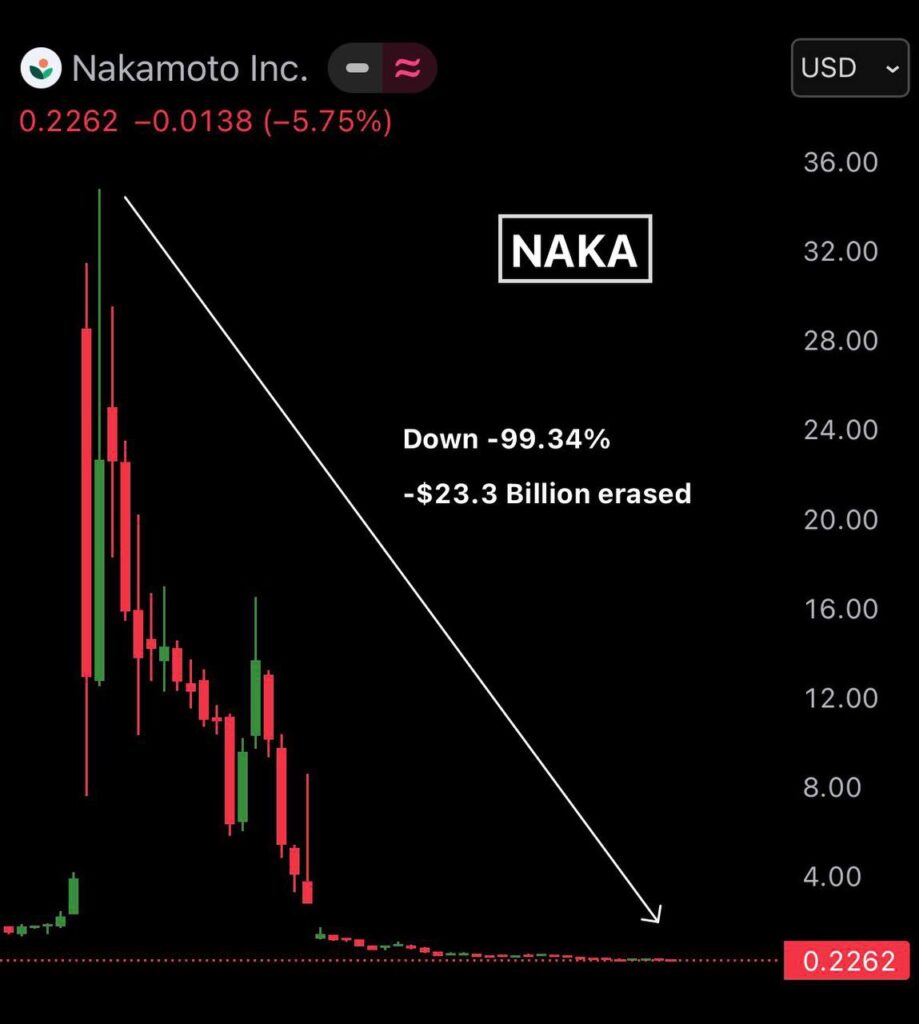
It is no coincidence that shares of Nakamoto, associated with David Bailey, collapsed by more than 99%. This is no longer just a correction – it is essentially a loss of investor confidence. In such situations, the market reacts not only to numbers, but also to the business model itself: if a company is heavily tied to a volatile asset, it automatically inherits its risks.
At the same time, important processes are happening inside the company. The sale of BTC in March is not panic and not a rejection of the strategy. It is an attempt to balance between long-term idea and short-term reality. The proceeds are directed to operational activity, business support, and working capital needs. In simple terms, the company converts part of “digital gold” back into money to keep operating here and now.
Additionally, Nakamoto sold about 5 million shares of Metaplanet for about 11.1 million dollars. This is another signal: liquidity becomes more important than holding all assets at any cost. Especially against the backdrop of active corporate expansion. In February 2026, the company completed deals to acquire BTC Inc. and UTXO Management, with a significant part of financing coming through equity issuance. That is, the company is simultaneously expanding and experiencing pressure – a combination that requires careful capital management.
Nakamoto’s official position remains unchanged. The company emphasizes that it considers Bitcoin a long-term strategic asset, and current sales are only an element of liquidity management. This is an important distinction: one thing is to hold an asset “for growth”, and another is to ensure current business operations. In theory, this sounds reasonable. In practice, it requires almost surgical balance.
At the same time, the market situation shows another interesting detail. Despite pressure and caution from many companies, there are players who continue to act aggressively. For example, Strategy remains practically the only major buyer among corporate BTC holders. Over the past 30 days, it has acquired about 45,000 BTC – this is the most intense accumulation phase in a long period. Against the backdrop of sales by other companies, this looks like a bet against the market or, if you will, faith in a long-term scenario.
In the end, a rather illustrative picture emerges. On one side – companies that are forced to partially realize losses and maintain liquidity. On the other – players continuing to increase positions despite volatility. This is no longer a single trend, but a divergence of strategies.
And the main conclusion here is not so much about a specific company, but about the model itself. Bitcoin as a corporate reserve is not just an investment, but a management decision with consequences at all levels: from accounting to share price. It can strengthen a business in a rising market phase, but just as quickly becomes a source of pressure in a declining phase.
The market, as usual, does not forgive extremes. And the Nakamoto story shows this almost like a textbook: holding Bitcoin is easy when it rises. Managing it as part of a business is a completely different task.
All content provided on this website (https://wildinwest.com/) -including attachments, links, or referenced materials — is for informative and entertainment purposes only and should not be considered as financial advice. Third-party materials remain the property of their respective owners.