


? Arthur Hayes, co-founder of the BitMEX platform, stated that the well-known four-year Bitcoin cycle no longer works — and the reason is not what traders usually think.
“When the fourth anniversary of this cycle arrives, traders want to apply the historical pattern and predict the end of the current bull market,” Hayes wrote in his blog on October 9.
According to him, although the four-year pattern worked in the past, it is now obsolete and “will fail this time.”

The Four-Year Bitcoin Cycle: History and Logic
To understand Hayes’s point, we need to recall what the four-year cycle actually is.
Origin of the cycle
The essence of the cycle is tied to halving — a built-in mechanism in Bitcoin’s code that cuts miners’ block rewards in half every four years.
A lower supply of new coins has historically led to an increase in BTC price when demand remains stable.
How It Worked Before
- First cycle (2012–2013): reward dropped from 50 to 25 BTC, price rose from ~$12 to ~$1,000.
- Second cycle (2016–2017): reward fell to 12.5 BTC, price reached ~$20,000.
- Third cycle (2020–2021): reduction to 6.25 BTC coincided with a price rally to nearly $69,000.
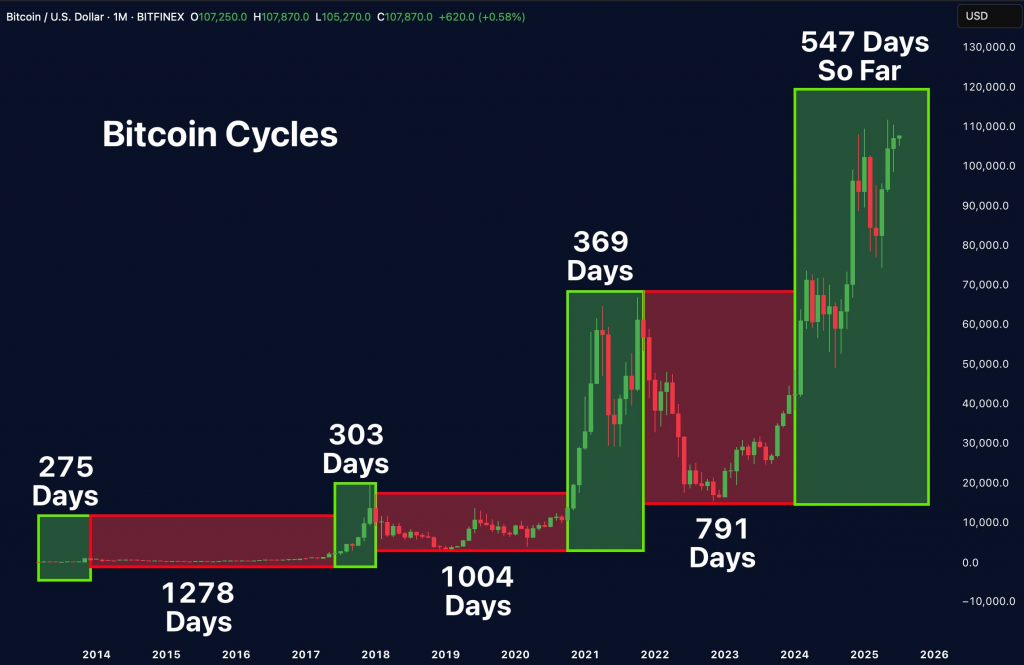
Bitcoin cycle chart. Source: Merlijn The Trader
Each cycle included:
- an accumulation phase after a drop,
- a rally following emission reduction,
- euphoria at the price peak,
- correction as liquidity dried up.
This repeating pattern formed the theory of the “four-year cycle,” where halving acted as Bitcoin’s “metronome.”
Why Hayes Thinks the Cycle Is Obsolete
Hayes argues that Bitcoin’s price is now determined by monetary policy, not time patterns:
- The key factor is liquidity, mainly U.S. dollars and Chinese yuan.
- Cycles no longer “kill” or “boost” halvings; capital flows and central bank actions are now decisive.
He cites several current factors distinguishing this cycle:
- The U.S. Treasury is withdrawing $2.5 trillion from the reverse repo program, issuing more Treasury bills.
- U.S. policy focuses on soft economic stimulation despite high debt levels.
- Plans for bank deregulation aim to increase lending.
- The Fed has resumed rate cuts despite inflation above target; CME forecasts two more cuts in October and December.
History Repeats — With Adjustments
Looking back:
- The first bull market (2012–2013) coincided with Fed quantitative easing and credit expansion in China, ending when both slowed money issuance.
- The second cycle (2015–2017) was driven by Chinese credit growth and yuan devaluation, not the halving.
- The third cycle (2020–2021) was fueled by dollar liquidity and ended when the Fed tightened policy.
Hayes notes that China no longer plays its former role as a “cycle killer.” With both the U.S. and China pursuing moderately accommodative policies, liquidity could fuel Bitcoin growth even without direct intervention from Eastern central banks.

What does it mean for investors?
- The four-year pattern no longer guarantees peaks and downturns.
- Bitcoin now moves to the rhythm of central banks, not halving mathematics.
- Price forecasts must consider monetary policy, global liquidity, and macroeconomic trends — not just halving dates.
Skeptics like Glassnode still see similarities to previous cycles, but if Hayes is right, the familiar “rise–correction–new high” rhythm may be gone for good.
“Listen to the monetary rulers in Washington and Beijing. Money will get cheaper, and there will be more of it. That’s why Bitcoin keeps rising in anticipation of that future,” Hayes concludes.
⏳ Conclusion
Investors must now understand: Bitcoin no longer dances to the halving’s tune — it moves to the global financial symphony.
The historical four-year cycle that once gave a sense of predictability is giving way to a more complex dependency on macroeconomic forces.
And as central banks play the “melody of liquidity,” Bitcoin remains the brightest star in the digital market.
All content provided on this website (https://wildinwest.com/) -including attachments, links, or referenced materials — is for informative and entertainment purposes only and should not be considered as financial advice. Third-party materials remain the property of their respective owners.