


A dispute over cryptocurrencies has split a dynasty of Swiss bankers. In one of Switzerland’s oldest banking families, a conflict has erupted that clearly illustrates the main fault line of the modern financial industry – between tradition and digital assets, Bloomberg reports. The story involves the Syz family behind Syz Group, where disagreements over crypto led not just to a strategic debate but to an actual split in the business.
Marc Syz, a representative of the new generation and head of the investment arm Syz Capital, has left the family structure along with his partner Richard Byworth. The formal trigger was a conflict over the integration of the crypto treasury company Future Holdings AG into the bank’s alternative investment division. However, at its core, this is a clash of two worldviews: traditional private banking, built on caution and risk management, and a new model where crypto assets are seen as a strategic asset class rather than a speculative add-on.
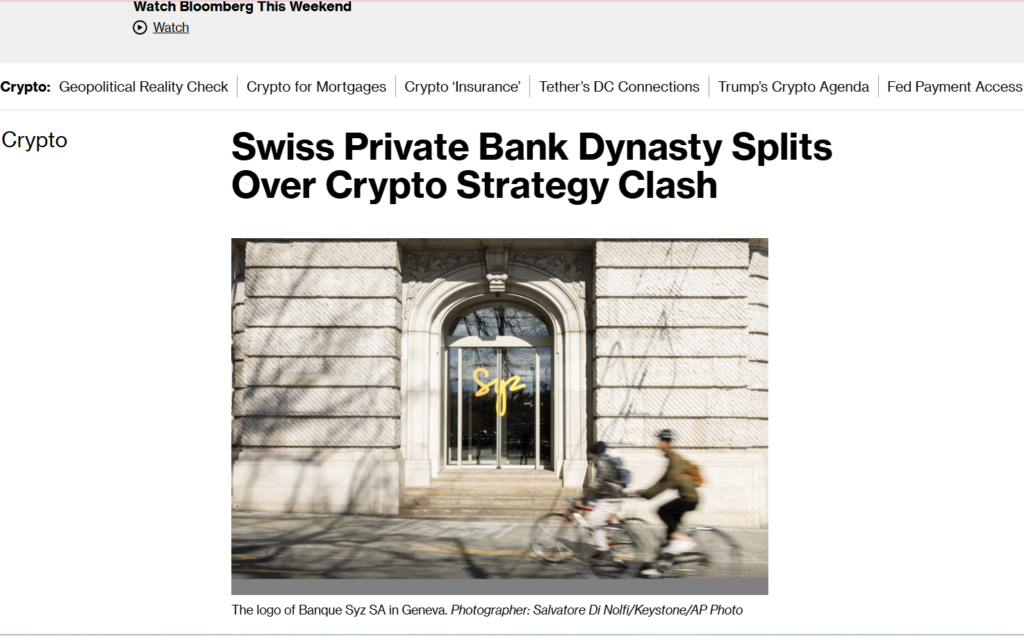
According to Marc Syz, the decisive moment was the intervention of the board of directors, which blocked the placement of Future Holdings within Syz Capital, citing elevated risks. For the older generation, this was capital and reputation protection. For the younger one – a missed opportunity to position in an emerging market segment. As a result, Marc Syz and Byworth not only stepped away from managing the crypto company but also left the bank itself, effectively starting an independent path.
Now their strategy looks much more aggressive. Together with Stifel Financial Corp., they are preparing a dual listing of Future Holdings in Sweden and Switzerland. The goal is ambitious: to create one of Europe’s largest public platforms focused on Bitcoin reserves, with a target accumulation of up to 3500 BTC. If successful, the project could become a European analogue of corporate crypto accumulation strategies already widespread in the United States.
At the same time, Marc Syz and his partner plan to launch a new independent asset management firm that will directly compete with the former family business. The focus is on alternative strategies, including digital assets, and on clients willing to accept higher volatility in exchange for potential returns. In essence, this is an attempt to create a “new private banking” – more flexible, technologically driven, and less constrained by conservative limits.
From the older generation’s perspective, the reaction has been restrained. Syz Group confirmed the departure of key figures and emphasized that alternative investments remain an important direction. However, the refusal to integrate the crypto project shows a boundary the bank is not yet willing to cross.
It is important to understand the scale of what is happening. Syz Capital, founded by Marc Syz in 2018, managed about 2 billion Swiss francs in assets at the time of his departure. The entire Syz Group stands at around $32 billion. This is not a startup or an experiment, but a full-fledged player in the private banking market. And if a conflict over cryptocurrencies arises within such a structure, it is no longer a niche story but a sign of a broader industry shift.
The context further amplifies the significance. The Swiss private wealth management market is under pressure: competition from large international banks is increasing, client preferences are changing, and new generations of investors are increasingly turning to alternative and digital assets. For smaller and mid-sized banks, the question is no longer whether to enter crypto, but how to do so without losing control over risk.
Meanwhile, Syz Group itself has been undergoing a series of transformations in recent years: selling off certain businesses, restructuring, and attempting to strengthen its position in key financial centers. Despite relative asset stability, growth in 2024 showed that the bank can still adapt. But the internal family conflict suggests that the strategy of this adaptation remains a matter of debate.
Particular interest lies in the future of Future Holdings. If the dual listing succeeds and attracts institutional investors, it will serve as an important test for the entire crypto treasury model in Europe. In effect, the market will get an answer to the question: are traditional investors ready to view Bitcoin not as a risk, but as part of a long-term portfolio balance.
In the end, the Syz family story goes far beyond a personal conflict. It reflects a broader process in which the old financial model collides with a new reality. Where the older generation sees risk, the younger sees opportunity. And as practice shows, such disputes rarely end in compromise.
Private banking has for decades been built on the principle “preserve first, then grow.” The crypto industry предлагает the opposite logic: “those who do not take risks fall behind.” And the question now is not who is right, but which of these models will prove closer to the future.
All content provided on this website (https://wildinwest.com/) -including attachments, links, or referenced materials — is for informative and entertainment purposes only and should not be considered as financial advice. Third-party materials remain the property of their respective owners.