

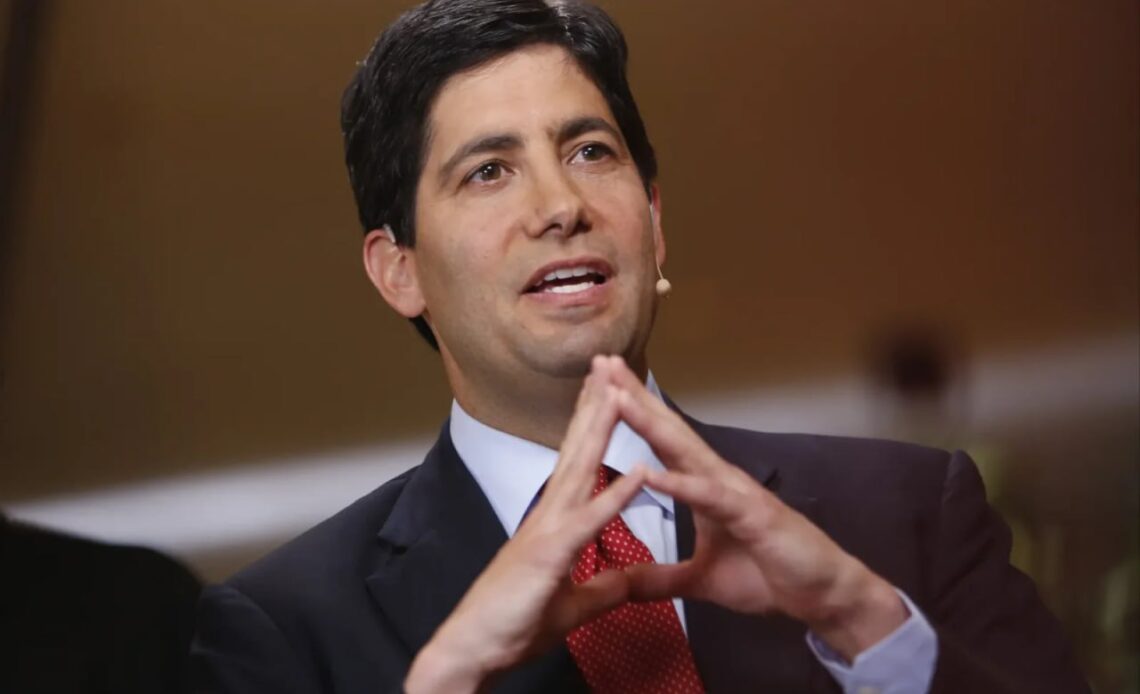
News about the possible appointment of Kevin Warsh as Chairman of the US Federal Reserve may appear routine at first glance. In reality, this could be the most atypical Fed chair in the regulator’s entire history — a person who is not only familiar with Bitcoin but publicly acknowledges its value as an economic and political indicator.
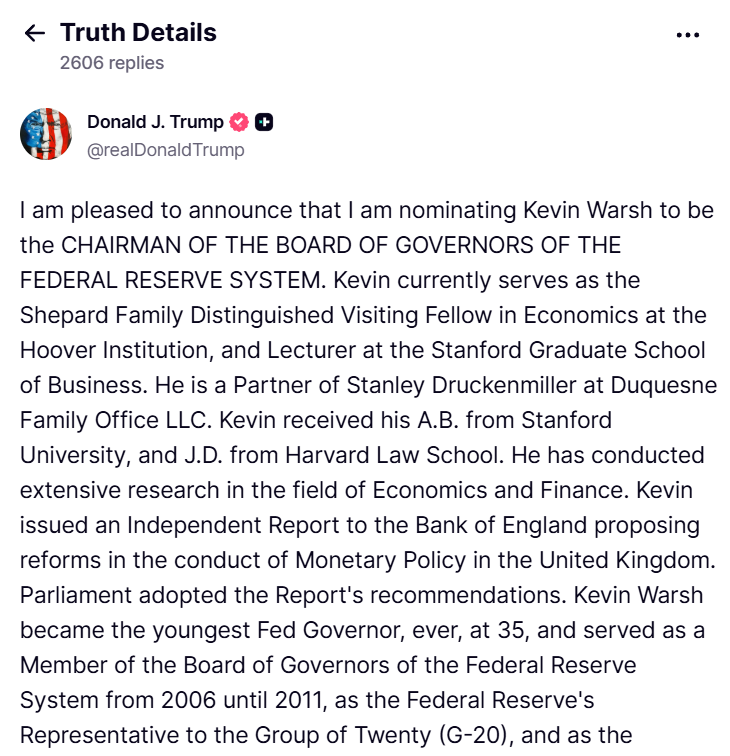
Donald Trump has officially stated that Kevin Warsh will become Chairman of the Federal Reserve, adding a characteristic remark: “I am confident that he will go down in history as one of the greatest Fed chairs, possibly the best.” For the crypto market, this statement carries special weight not because of Trump, but because of Warsh himself.
Who Is Kevin Warsh
Warsh is an atypical figure for the American central bank. He became the youngest Fed governor in history, receiving his appointment at the age of 35. He worked within the system from 2006 to 2011 — meaning he entered before the financial crisis and left after the world had seen the consequences of ultra-loose monetary policy.
Before and after his tenure at the Fed, Warsh worked closely with one of the most well-known macro investors of our time, Stanley Druckenmiller. This is important because Druckenmiller is known for his harsh criticism of debt-driven economics, quantitative easing, and politicized markets. It was within this intellectual environment that Warsh’s views were shaped.
Unlike most regulators, he is not a classic bureaucrat or academic economist. He is a practitioner focused on market signals rather than models alone.
According to Warsh himself, he first encountered Bitcoin back in 2011 after reading Satoshi Nakamoto’s whitepaper. At the time, like many others, he failed to grasp the scale of the phenomenon. Later, Warsh publicly acknowledged that he had underestimated the technology and its implications for the financial system.
This point is significant in itself. Very few members of the financial establishment are willing to publicly say, “I was wrong.” For a regulator of this level, that is almost exotic.
What Warsh Has Said About Bitcoin
In public speeches and interviews, Warsh has consistently expressed several key ideas that sharply contrast with the traditional rhetoric of central banks.
First, he has stated directly that criticism of Bitcoin as a threat to the Fed may be misguided. In his view, Bitcoin does not necessarily undermine the system but rather disciplines it. In other words, BTC does not destroy trust in monetary policy; it stress-tests it.
Second, Warsh has repeatedly emphasized that Bitcoin does not concern him as a regulator. This is an extremely atypical position. Most central bank leaders either express caution or frame crypto as a risk to financial stability.
Third, he has suggested that for people under 40, Bitcoin may serve as “new gold” — a store of value in a world where trust in fiat currencies is gradually eroding. At the same time, he does not place BTC above gold or set them directly against each other, but instead speaks of a generational shift in how value is perceived.
One of Warsh’s key theses is that Bitcoin is important primarily as an indicator. According to him, BTC shows policymakers and regulators when economic policy is failing. He interprets growing interest in Bitcoin as a signal of distrust in monetary experiments, not as a conspiracy against the dollar.
He has explicitly stated that Bitcoin is not a replacement for the dollar. It is neither an alternative to the national currency nor an attempt to destroy it. Rather, it functions as a kind of “market policeman” that provides feedback to authorities through price and demand.
Within this framework, Bitcoin is not a competitor to the Fed but a mirror of its decisions. When policy is stable and predictable, interest in BTC declines. When inflation, debt expansion, and manual market intervention emerge, Bitcoin responds by rising.
Why Warsh Does Not Consider BTC a Currency
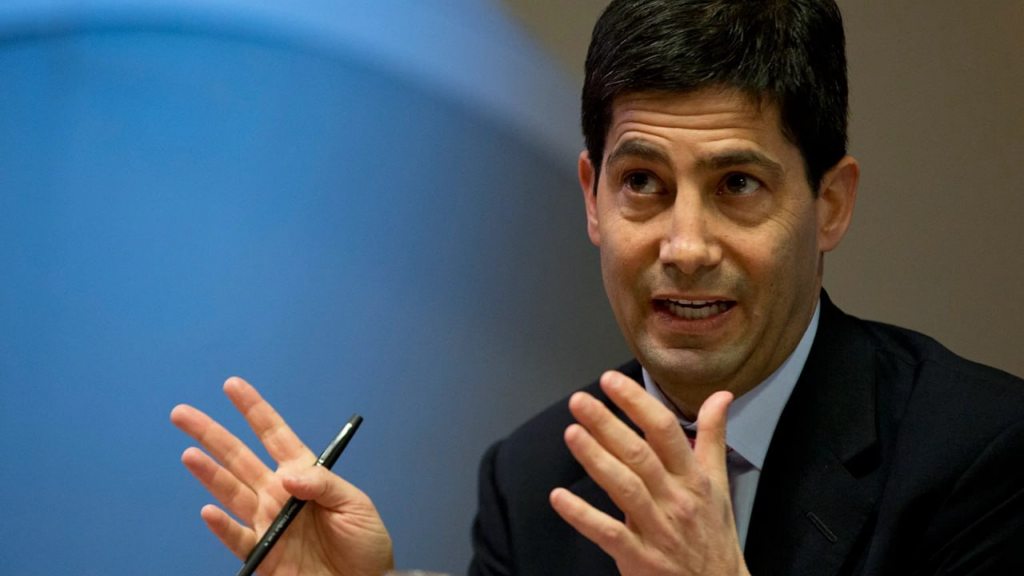
It is also worth highlighting his position on terminology. Warsh has repeatedly noted that the term “cryptocurrency” is misleading. In his view, Bitcoin is not a currency in the classical sense, but software.
At the core of BTC lies code that enables previously impossible scenarios — from decentralized accounting to trust mechanisms independent of governments. According to him, technology cannot be judged from a moral standpoint. Like any software, it can be used for both good and bad purposes.
He has also emphasized that the crypto industry follows the path of any new technology: there are genuine innovators, imitators, and incompetent participants. This is not an argument against the technology but a natural stage of its development.
Why a Warsh Appointment Would Change the Rules
If Kevin Warsh does indeed become Fed chair, it would set a precedent. For the first time in history, the US central bank could be led by someone who publicly understands the economic logic of Bitcoin and does not perceive it as an existential threat.
This does not mean the Fed would suddenly become “pro-crypto” or begin encouraging BTC. But it would signal a shift in perspective — from a logic of bans and fears to a logic of analysis and market signals. Warsh neither romanticizes Bitcoin nor demonizes it. He sees BTC as a feedback tool, a mechanism of discipline, and an indicator of policy mistakes. For a regulator of this level, this is an almost revolutionary approach.
In the final analysis, Bitcoin under Warsh would be neither an enemy nor a savior. It would be an indicator, a test, and a reminder that trust cannot be printed. And if such a person were to lead the Fed, the attitude of the world’s main financial regulator toward the crypto industry would inevitably become more mature and less ideological.
For the market, this may be even more important than loud statements or new ETFs.
All content provided on this website (https://wildinwest.com/) -including attachments, links, or referenced materials — is for informative and entertainment purposes only and should not be considered as financial advice. Third-party materials remain the property of their respective owners.