

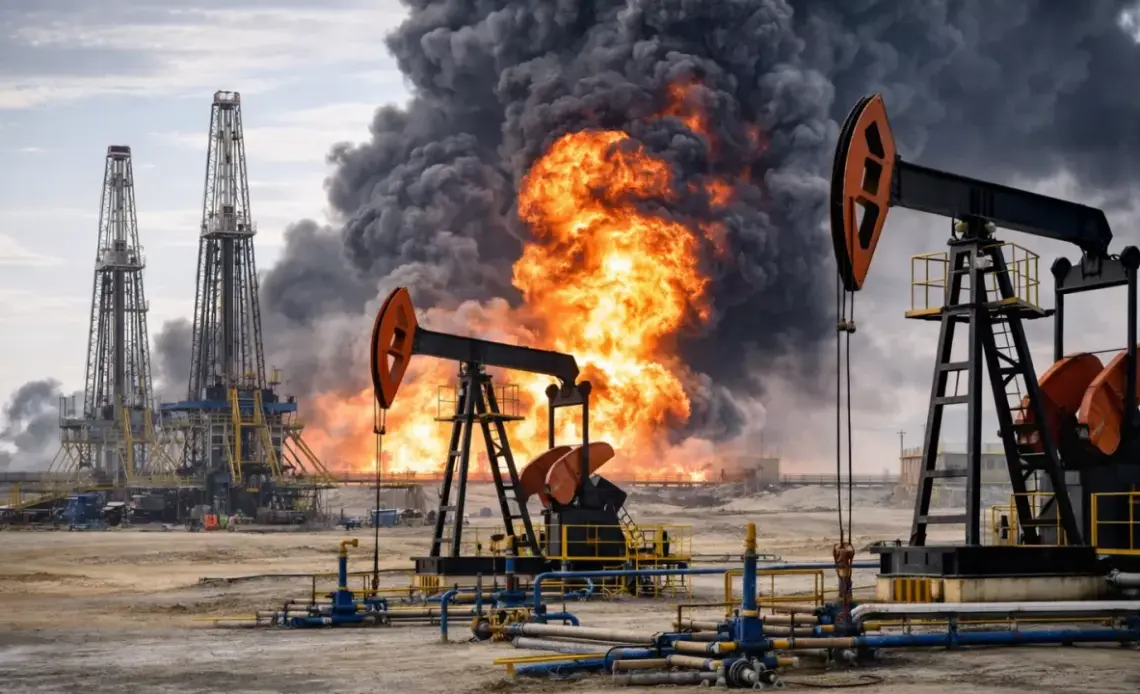
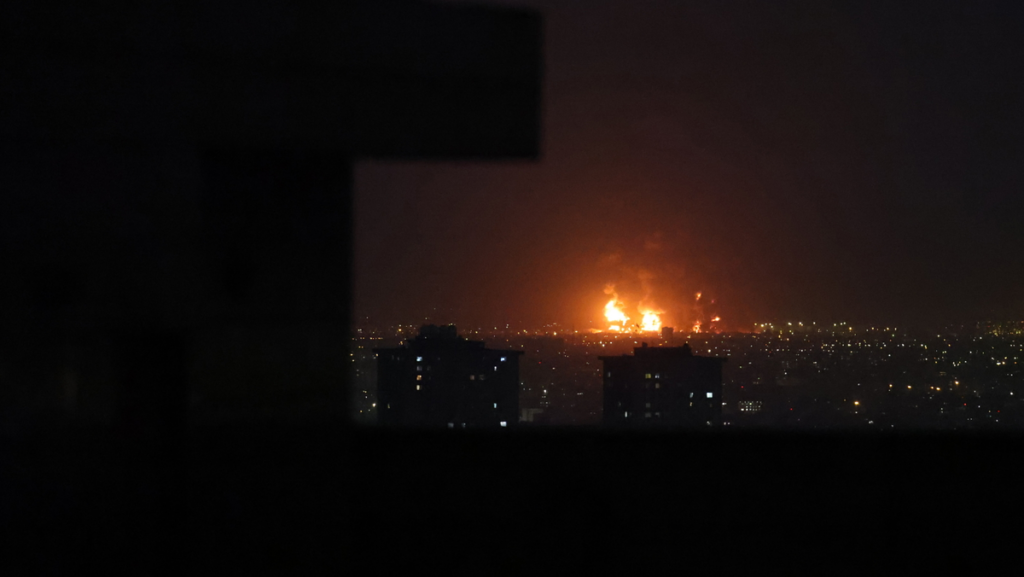
A new escalation of tensions in the Middle East has sharply increased anxiety across global financial and commodity markets. Reports of strikes on oil infrastructure facilities in Iran have intensified investor concerns about the stability of energy supplies. The situation is complicated by the fact that the events are unfolding in one of the world’s key energy regions, which accounts for a significant share of global oil production and exports.
According to market sources, the strikes targeted facilities connected to Iran’s oil industry. Such actions are traditionally perceived as an extremely sensitive factor for the global energy system. Oil remains the backbone of the world economy: transportation, industry, electricity generation, and a large share of international trade depend directly on its price.
In recent years the market has repeatedly reacted to geopolitical events in the Middle East with sharp price spikes. However, the current situation is causing particular concern because of the potential consequences for the entire infrastructure of oil production and transportation in the region.
Particular concern surrounds the strategically important maritime route — the Strait of Hormuz. This narrow sea corridor connects the Persian Gulf with the world’s oceans and is one of the most critical transport routes for global energy supplies. According to various estimates, about 20 percent of the world’s oil exports pass through it.
At the moment the strait remains closed to part of shipping traffic, significantly increasing the risk of supply disruptions. Even temporary restrictions in this area can cause serious shocks in energy markets. Any threats to tanker routes are immediately reflected in oil futures and in investor sentiment around the world.
In addition, several Persian Gulf countries have already confirmed partial production cuts. Among them are Kuwait, United Arab Emirates, Saudi Arabia, Iraq, and Qatar. Even temporary reductions in production in these countries could significantly change the balance of supply and demand in the global oil market.
An important feature of the oil industry is that production cannot be stopped and restarted instantly. Unlike many other industries, oil infrastructure requires complex technological processes. If production is halted due to security threats or damage to facilities, restoring operations can take days, weeks, or sometimes months.
This means that even a short-term conflict can lead to long-term consequences for the energy market. If infrastructure damage proves serious or transportation routes are blocked, the global supply system may face shortages.
Against this backdrop, analytical platforms and prediction markets are trying to assess the economic consequences of the situation. The platform Polymarket estimates the probability that the average gasoline price in the United States will exceed $4.25 per gallon already in March at about 53 percent. This is classic stagflation: inflation rises while the economy slows. Such a scenario would mean a sharp increase in fuel prices within just one month.
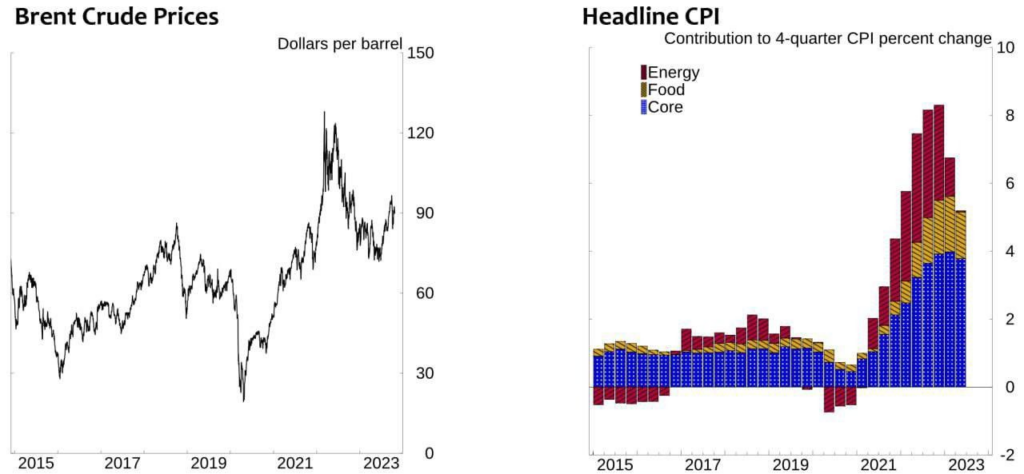
Higher fuel costs could place significant pressure on the U.S. economy. More expensive energy increases production costs, raises transportation expenses, and reduces consumers’ purchasing power. Altogether, this could lead to accelerating inflation and slowing economic growth.
That is why some economists have again begun discussing the risk of stagflation — a situation in which the economy simultaneously faces high inflation and weak growth. Such periods are considered especially difficult for financial markets because traditional economic policy tools become less effective.
Amid the current uncertainty, financial markets are showing extremely high volatility. Investors are trying to rapidly reassess risks and reallocate capital across different asset classes. Under such conditions even minor news can cause significant price swings.
According to a number of analysts, the base scenario for the next trading sessions may be further growth in oil prices. If tensions around supplies persist, prices could approach the level of $100 per barrel. Such a development would have a serious impact on stock markets.
Rising oil prices traditionally put pressure on shares of companies not related to the energy sector. More expensive energy reduces business margins, increases costs, and may slow economic activity. This is especially sensitive for companies in the transportation industry, manufacturing, and the consumer sector.
Therefore, further increases in oil prices could negatively affect the dynamics of the S&P 500, which reflects the condition of the largest companies in the American economy.
The cryptocurrency market may also come under pressure. Although some investors view digital assets as an alternative store of value, during periods of global instability capital often moves out of riskier assets. Under such conditions even Bitcoin may show increased volatility.
Ultimately, the events unfolding could become one of the most serious geopolitical shocks for the energy market in recent years. Their further development will depend on several factors: Iran’s reaction, the position of the Persian Gulf countries, the condition of maritime transport routes, and the actions of major world powers.
In the coming days these factors will determine the dynamics of oil prices, global stock markets, and cryptocurrencies.
A video fragment of the attack itself can be viewed on our Telegram channel.
All content provided on this website (https://wildinwest.com/) -including attachments, links, or referenced materials — is for informative and entertainment purposes only and should not be considered as financial advice. Third-party materials remain the property of their respective owners.