

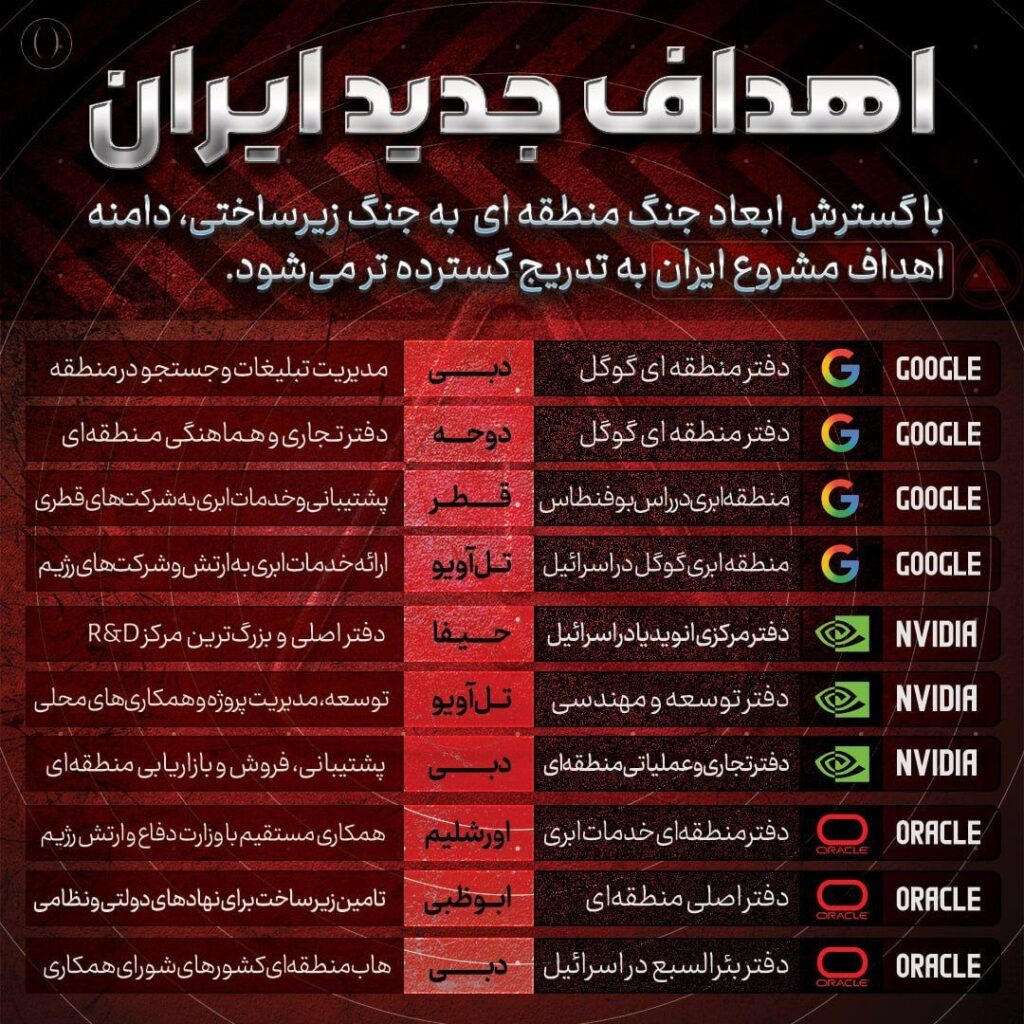
Statements by the Islamic Revolutionary Guard Corps about possible attacks on US technological infrastructure in the Middle East are sharply increasing tensions not only in the region but also in the global economy. According to Iranian sources, starting from the evening of April 1, the list of potential targets includes facilities of major American corporations such as Microsoft, Apple, Google, Nvidia, as well as Amazon, Oracle, IBM and Palantir.
According to publications distributed through the Iranian agency Tasnim, this is not about symbolic threats but about an expansion of the target list, which now specifically includes technological infrastructure. In Tehran, it is believed that the services and solutions of these companies are used to support military and intelligence operations of the opponent, and therefore automatically fall into the category of strategic targets. This fundamentally changes the nature of the conflict: if previously energy, logistics and military bases were mainly targeted, now the focus is on digital infrastructure, without which the modern economy effectively cannot function.
At the same time, Iran has stated its intention to strike economic targets — banks, financial centers and commercial infrastructure of the US and Israel in the region. The reason, according to their version, was a recent strike on one of the banks inside the country. In response, Tehran directly warns of reciprocal actions and even urges civilians to avoid being near financial institutions, which looks like a signal of a high probability of escalation.
Particular attention is drawn to the fact that such threats have already been partially backed by actions. Earlier this month, the IRGC reported drone attacks on data centers linked to the cloud infrastructure of Amazon Web Services in Bahrain and Dubai. According to The New York Times, several facilities were damaged, which became the first signal that digital infrastructure is indeed being treated as a target rather than merely a rhetorical tool of pressure.
If the threats are carried out, the consequences could extend far beyond the region. Data centers and cloud services ensure the operation of banking systems, logistics, communications, government services and corporate platforms. Strikes on such facilities could trigger a chain reaction — from disruptions in local services to interruptions in international operations of companies dependent on cloud computing.
In fact, this signals a transition of the conflict into a new phase — a hybrid one, where alongside physical targets, digital infrastructure comes under attack. This is no longer just a military confrontation but a struggle for control over data, computing power and technological channels of governance.
Markets, as usual, react faster than politicians. Rising tensions in the region traditionally put pressure on global supply chains, increase energy prices and boost demand for safe-haven assets. But in this case, another factor is added — the risk of technological disruptions. If previously investors priced in oil supply disruptions, now they also have to consider potential failures in cloud services and digital infrastructure.
At the same time, an important question remains — to what extent these statements are a tool of pressure and to what extent they represent a real plan of action. In such conflicts, information warfare plays no lesser role than actual strikes. The very threat of attacks on major technology companies already influences the behavior of markets, companies and governments.
Nevertheless, the very emergence of such statements shows how much the nature of global conflicts has changed. If earlier strategic assets were oil, transport hubs and military bases, today they are joined by data centers, cloud platforms and technological ecosystems.
And the main conclusion here is quite harsh. The world is rapidly moving toward a situation where the boundaries between military, economic and digital warfare are blurring. And if previously infrastructure could be protected physically, now the very architecture of the modern economy is under threat. This is a level of risk that markets are only beginning to get used to.
All content provided on this website (https://wildinwest.com/) -including attachments, links, or referenced materials — is for informative and entertainment purposes only and should not be considered as financial advice. Third-party materials remain the property of their respective owners.