


Last week, analysts from major investment banks revised their ratings for several notable companies at once. Such rating changes rarely occur randomly. As a rule, they reflect deeper shifts in market expectations, risk assessments, and forecasts of future profits. For investors, such revisions often serve as early signals: where the analytical community begins to see growth potential, and where, on the contrary, concerns and the likelihood of deteriorating financial performance are increasing.
Let us consider several illustrative cases that clearly demonstrate how market sentiment is currently changing.
The situation around Jefferies Financial Group has become an example of how quickly analysts’ attitudes toward financial institutions can change. Morgan Stanley downgraded Jefferies shares to Equal-weight and set a target price of around $49. The main reason for the revision was growing legal risks and the associated costs. According to analysts, the company is facing increasing expenses related to legal support and consulting services.
Additional pressure comes from weakness in key business segments. Investment banking is going through a less active period due to a decline in the number of deals in the capital markets, while the fixed income trading segment is showing weaker results than previously expected. As a result, the earnings forecast for the first quarter of 2026 was reduced by about 20 percent.
Some analysts also allow for a more negative scenario. If the company’s market valuation falls to around 0.7 of book value, the share price could theoretically decline to around $27. Such a scenario is not considered the base case, but the very fact that it is being discussed shows that the market is beginning to factor in additional risks and may abandon the company’s previous premium valuation.
A completely opposite dynamic was demonstrated by Hims & Hers Health. Investment bank Bank of America upgraded its stock rating to Neutral and almost doubled the target price from $12.5 to $23. The main reason for this revision was an important legal development that significantly reduced business risks.
This refers to the decision of pharmaceutical giant Novo Nordisk to withdraw a lawsuit related to the obesity treatment drug Wegovy. This conflict had long remained one of the main sources of uncertainty for Hims & Hers. After the threat of litigation was removed, analysts began revising their forecasts for future revenue.

The market can now start to more actively factor in the potential sales of GLP-1 class weight loss drugs, which in recent years have become one of the fastest-growing segments of the pharmaceutical industry. The reduction of legal risks also creates room for valuation multiple expansion, as investors begin to price in a more stable business growth model.
Analysts’ optimism was also reflected in their view of the Chinese electric vehicle manufacturer NIO. Investment bank Nomura upgraded the company’s rating to Buy and set a target price of about $6.60.
Despite the difficult economic environment and increasing competition in the electric vehicle market, analysts see signs of gradual business recovery. In recent months, the company has been increasing vehicle deliveries, which is considered a key indicator of demand. In addition, NIO is expected to approach operational break-even by 2026, which would become an important psychological milestone for investors.
Currently, the company’s shares are trading at roughly 0.7 times annual revenue, which by historical standards is considered a relatively low valuation for a technology-driven automaker. Analysts believe that if the current delivery dynamics continue, the market may gradually begin to revise the company’s valuation upward. Even in the context of a slowing global economy, deliveries are expected to grow by about 25 percent per year.
Another notable upgrade occurred for the American healthcare giant CVS Health. Analysts from Bernstein Research upgraded the stock to Outperform and set a target price of about $94.
The key factor behind the improved assessment was the gradual reduction of regulatory uncertainty surrounding the PBM segment – companies that manage pharmaceutical benefit programs. This business had long been under pressure from regulators and politicians, which caused concern among investors. However, recent signals indicate that this pressure may gradually weaken.

Additional optimism is linked to the prospects of the insurance division Aetna, which could significantly increase the profitability of the business. According to analysts’ estimates, the company’s earnings per share could grow by about 9 percent annually until 2029. At the current valuation of about 12 times annual earnings, the company is beginning to appear undervalued compared to historical levels and competitors.
On the opposite side stands the software developer PagerDuty. Analysts from the investment firm William Blair downgraded the stock to Market Perform.
The main reason was a noticeable loss of growth momentum. Annual recurring revenue has almost stopped increasing, which is a worrying signal for companies operating under a subscription model. At the same time, the customer retention rate declined to about 98 percent. Although formally this is still a high level, for SaaS companies such dynamics are perceived as a warning sign of possible market saturation.
In addition, competition from major technology platforms is intensifying, as they are gradually starting to offer similar tools within their own ecosystems. As a result, the revenue growth forecast by 2027 looks extremely modest. Even with a relatively low valuation, analysts do not see clear catalysts that could accelerate the company’s development in the coming years.
All these rating revisions provide a rather interesting picture of the current state of the market. One can observe a clear division between companies that demonstrate stable growth or have strong future drivers and those where signs of business slowdown are emerging. Companies with weakening sales dynamics begin to receive downgrades because investors are increasingly unwilling to pay for stories without clear growth.
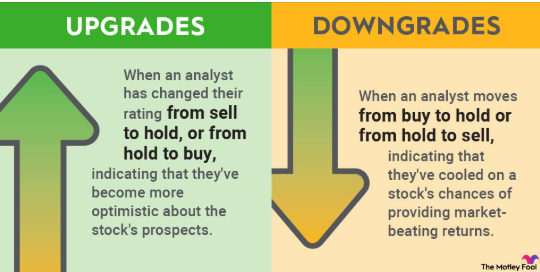
At the same time, firms facing legal or regulatory risks can quickly lose their premium valuation if uncertainty increases. This is currently happening in the case of some financial companies.
At the same time, stories where strong catalysts appear – whether the removal of legal risks, improvements in the regulatory environment, or prospects for increased product deliveries – receive noticeable support from analysts. The examples of Hims & Hers, CVS, and NIO show that the market is still willing to revise valuations upward when convincing arguments for future growth emerge.
In a broader sense, these changes confirm an important trend: the market is becoming much more selective. Investors are increasingly less focused on general macroeconomic expectations and more concentrated on specific growth stories. Capital is now more often directed toward companies with clear strategies, strong development drivers, and relatively low risks.
In other words, the market is once again beginning to pay primarily for growth and clarity of the future. These are the companies that receive upgrades today, while businesses with uncertain prospects are increasingly facing downgrades and more cautious forecasts from analysts.
All content provided on this website (https://wildinwest.com/) -including attachments, links, or referenced materials — is for informative and entertainment purposes only and should not be considered as financial advice. Third-party materials remain the property of their respective owners.