


This is exactly the kind of story that sounds like it was written not by an analyst, but by someone from Hollywood after their third cup of coffee. Let’s start with the main point: Milla Jovovich suddenly appears not just as an actress from The Fifth Element and the face of the Resident Evil franchise, but as a participant in developing an AI tool. And not just “trying it out” – according to her, she acted as the architect of the project. That already sounds like quite an unexpected career turn, to put it mildly.
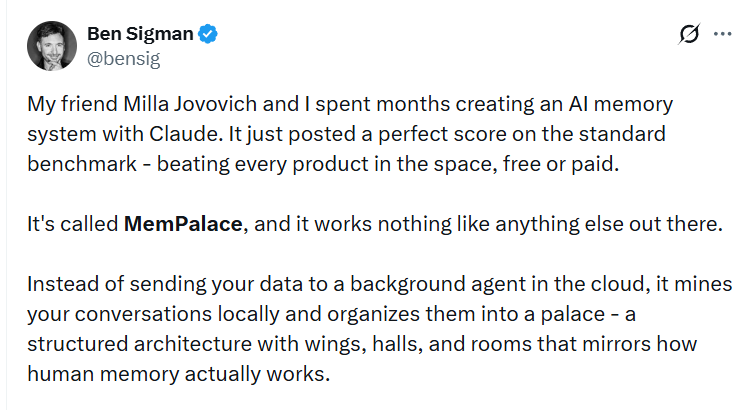
The project in question is MemPalace, promoted by Ben Sigman, the head of the crypto startup Libre. According to him, he and Jovovich spent several months building a tool designed to solve one of the most painful problems of modern AI agents – memory.
And this is where things get interesting. MemPalace is built on a technique as old as ancient philosophers – the method of loci, better known as the “memory palace.” The idea is simple and has been tested for thousands of years: you create a mental space (a palace, a house, a route) and “place” information in different rooms. To recall it, you mentally walk through this space and retrieve the data.
Now this idea is being applied to AI. The concept behind MemPalace is to create a structured system for storing an agent’s “memories” about a user. The key focus is locality. Data does not go to the cloud, does not depend on subscriptions, and is stored directly on the user’s device. It sounds like a direct response to two major concerns: privacy and control.
Sigman presents the project as something close to a breakthrough. According to him, MemPalace:
- outperforms existing AI memory solutions
- does not require external services
- runs faster and more efficiently
- and, most importantly, “understands” when to use stored data
Translated from startup language into plain English, this is an attempt to make AI less like a goldfish and more like a conversation partner who actually remembers what you talked about yesterday.
But, as is often the case, the louder the claim, the more questions it raises.
First, the idea of “memory for AI” is not new. Nearly all major players are working on it – they just do it more quietly and without a Hollywood angle.
Second, the key question is not whether data can be stored, but how it is used. Memory without context is not intelligence – it is just storage. Jovovich’s involvement also raises understandable skepticism. Yes, she confirmed her role and explained it by saying she encountered problems while working on a “large game project.” According to her, trying to solve those issues led to the creation of MemPalace. She calls herself the architect, while referring to Sigman as the engineer.
It sounds compelling. But the market tends to ask a simple question: where is the line between real contribution and PR amplification?
Sigman’s post on X (formerly Twitter), featuring Jovovich, gathered millions of views – which is already telling. The project has attention. But attention is not the same as trust.

Looking at the bigger picture, the MemPalace story reflects the current stage of AI development. The industry is gradually shifting from the race of “who is smarter” to the question of “who remembers better and personalizes more effectively.” Because the next level of competition is not just answers – it is context. And here, the idea of a “memory palace” does make sense. It is not new, but it is logical. The real question is execution.
For now, MemPalace is an interesting concept with strong presentation, a recognizable name, and a relevant problem. But to reach the status of a true “breakthrough,” it still needs to go through the classic path – from a compelling story to verifiable results.
And if we are being completely honest – we are living in a remarkable time. A time when an actress from iconic sci-fi helps build memory systems for artificial intelligence. All that is left is for AI to start recalling the plot of The Fifth Element without hints – and the circle will be complete.
All content provided on this website (https://wildinwest.com/) -including attachments, links, or referenced materials — is for informative and entertainment purposes only and should not be considered as financial advice. Third-party materials remain the property of their respective owners.