

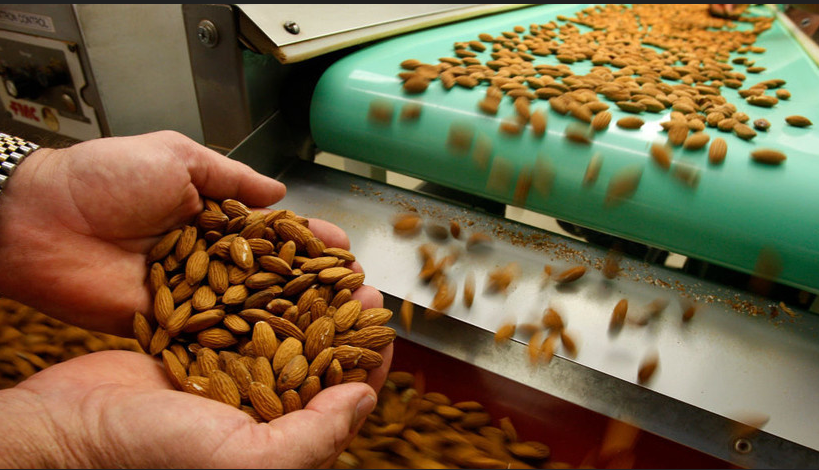
The United States has demonstrated a notable increase in almond exports to the Russian market, bringing shipment volumes to their highest level in the past three years. By the end of 2025, the value of products sold reached $564.1 thousand compared to $128.5 thousand a year earlier. Thus, on a year-over-year basis, exports grew 4.4 times. Although the absolute figures remain relatively modest on a global scale, the dynamics themselves are indicative and reflect shifts in trade flows within the agricultural sector.
The recorded shipment volume became the highest since 2022. At that time, US almond exports to Russia were estimated at $791.2 thousand. Afterward, figures declined, but in 2025 a sharp turnaround occurred. Formally, the current level has not yet reached the peak values seen three years ago, but the pace of recovery indicates renewed demand and the stabilization of supply channels.
The increase in shipments may be linked to several factors. First, almonds remain a sought-after product both in retail and in the food industry. They are used in the production of confectionery, plant-based milk, snacks, and ingredients for the healthy food segment. Second, global logistics chains have gradually adapted to new conditions, enabling exporters to restore their presence in markets where trade had previously contracted. Third, price conditions may have played a role: fluctuations in global nut and agricultural commodity prices often stimulate short-term purchasing spikes.
At the same time, Russia is not among the largest buyers of US almonds. The absolute leader in imports remains India, accounting for 21.1% of all US shipments. This is explained by both the scale of its domestic market and the traditionally high consumption of nuts in Indian cuisine.
The top five importers also include Spain with an 8.5% share, the United Arab Emirates at 7.3%, Turkey at 5.8%, and the Netherlands at 5.4%. These countries act either as major end-consumption markets or as important logistical hubs through which products may be redistributed further.
The United States traditionally holds leading positions in the global almond market thanks to large-scale production, primarily in California, which accounts for the lion’s share of global exports. American almonds are known for consistent quality standards, making them competitive internationally. Even amid shifts in the geopolitical environment, agricultural supplies often continue, as the food segment remains relatively flexible compared to industrial goods.
It is important to consider that the sharp percentage growth is partly explained by the low base effect of the previous year. The figure of $128.5 thousand was comparatively small, so increased purchasing volumes automatically resulted in multiple growth in relative terms. Nevertheless, the very fact that shipments recovered to a three-year high indicates sustained demand and functioning trade channels.
In a broader context, the dynamics of almond exports reflect the overall picture of global agricultural trade, where even amid political turbulence a pragmatic approach to ensuring food supply persists. Nuts and other food products remain part of a global supply chain in which price, quality, and logistics play a decisive role.
Thus, the increase in US almond exports to Russia to $564.1 thousand in 2025 became a notable development in terms of dynamics, although it does not alter the global distribution of trade flows. Large Asian and European markets remain the leaders in purchases, yet the recovery of shipments to the Russian direction shows that agricultural trade continues to adapt to new conditions and find a balance between supply and demand.
All content provided on this website (https://wildinwest.com/) -including attachments, links, or referenced materials — is for informative and entertainment purposes only and should not be considered as financial advice. Third-party materials remain the property of their respective owners.