

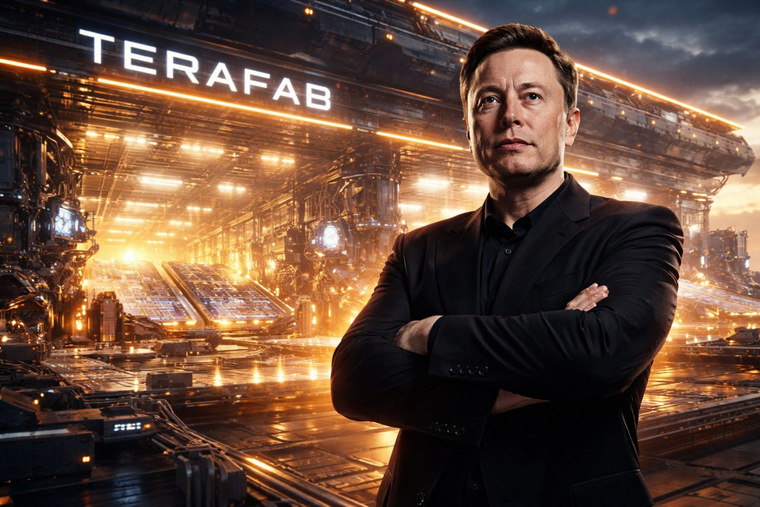
Elon Musk is once again doing what he does best — pushing the boundary between “this sounds crazy” and “this will be normal in 10 years.” His new project, called Terafab, at first glance looks like another attempt at vertical integration — in-house chips, less dependence on suppliers, faster development. But if you look deeper, it becomes clear: this is not about a factory. It’s about a shift in the scale of thinking.
Musk doesn’t start with economics, technology, or even business. He starts with philosophy. With the idea that humanity is still a “small civilization,” stuck on one planet and using only a tiny fraction of available energy. We divide Earth’s resources, argue over them, optimize processes… but ignore the main fact: the energy of the Sun exceeds everything we use by billions of times. And from this, his logic is simple, even slightly provocative. The problem is not a lack of resources. The problem is that we think too locally.
In this framework, Terafab is not just a chip factory. It is the first brick in the architecture of a civilization that moves beyond Earth. It all begins with a number that sounds almost absurd. Musk talks about producing such a volume of chips that operating them would require about 1 terawatt of energy. For comparison, this is comparable to the energy consumption of large countries. In the context of today’s Earth energy system, this is enormous. But in his worldview, it’s just a starting point.
Here comes the key idea: Earth’s limitation is energy. You can build data centers endlessly, but sooner or later you hit the ceiling of available power. In space, there is no such ceiling.
To realize this vision, Musk wants to combine the resources of several of his companies. SpaceX provides access to space, Tesla brings energy and engineering, and xAI provides the computational demand and the purpose of the entire infrastructure.
He is not just outlining a concept, but building on proven results. Tesla was once seen as a strange idea — electric cars “nobody needs.” Today it produces millions of vehicles per year. xAI has built massive computing clusters in record time. And SpaceX has achieved what was once considered science fiction — over 500 successful rocket landings, reducing launch costs by orders of magnitude.
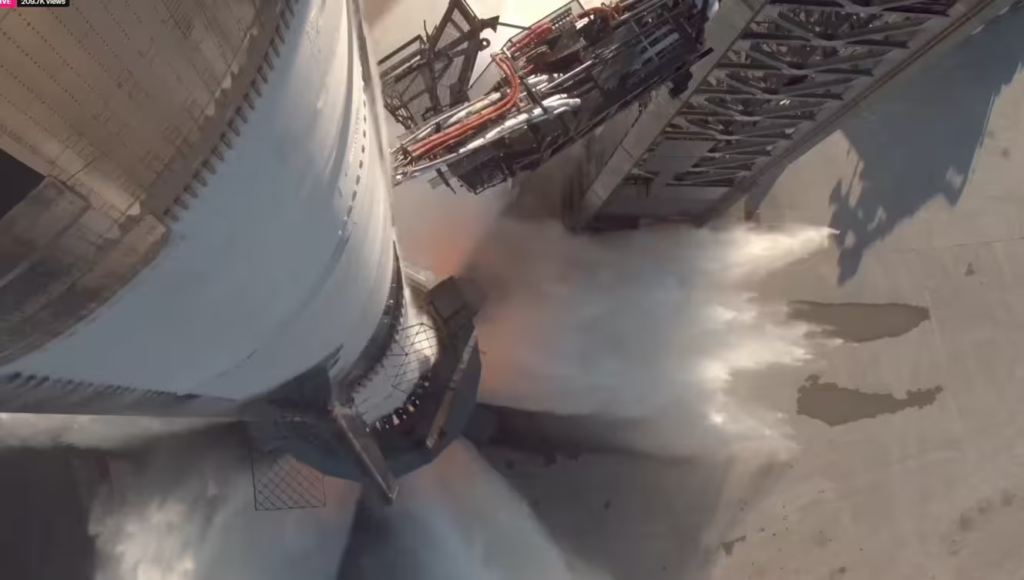
This is where the key tool of the concept appears: Starship. Musk is betting that this rocket will allow hundreds of tons to be delivered to orbit in a single launch. Space is no longer just an experiment — it becomes an industrial platform.
Then comes the most interesting part. Musk proposes building massive data centers directly in space. Not on Earth, not in deserts, not near power plants — but in orbit. The logic is surprisingly simple. In space there is no night, no atmosphere, no weather. Solar energy is constant. Cooling, which seems like a problem, is already solved — SpaceX operates thousands of satellites.
He talks about orbital AI centers larger than Starship itself. These are not just satellites, but full-scale infrastructure — computing factories floating above Earth. To reach 1 terawatt of capacity, he estimates about 10 million tons of equipment would need to be delivered into space. The number sounds extreme, but Musk emphasizes: this does not violate physics. It’s a matter of scale, not impossibility.
At this point, Terafab returns to the center of the story. Because the next step is not just building data centers, but rethinking chip production entirely. Today, the supply chain is spread across the globe — different countries, factories, logistics. Musk wants the opposite — everything in one place. Full-cycle production under one roof. Manufacturing, testing, iteration. Fast, aggressive, almost startup-like, but at an industrial scale. And this brings what the market lacks — speed. The ability to iterate quickly instead of waiting years.
He also highlights two types of chips.
One is for the “edge” — robots and autonomous systems. This connects directly to Optimus and the idea of mass-producing humanoid robots. Musk even suggests that in the future there could be many times more robots than cars.
The second type is for space. Chips designed for radiation, extreme environments, and harsh conditions. These become the backbone of orbital infrastructure.
Then the scale shifts again. Because even orbital data centers are not the end. They are just a step. Musk’s next move is the Moon. Here the idea moves into science fiction territory, but with engineering logic behind it. He describes a lunar base where an army of Optimus robots will mine resources and build even larger data centers — not twice as big, but hundreds or thousands of times larger. And launching them into space would no longer require rockets, but electromagnetic accelerators, drastically reducing costs.
The result is a chain: Earth — production and launch, orbit — computation, Moon — scaling. If you set aside the “this is too bold” reaction, there is internal logic here. The most interesting part is not even the technology, but the shift in how limitations are viewed.
Musk is essentially saying: the problem is not that resources are scarce. The problem is that we try to solve problems within a narrow framework. AI, energy, computing — all hit Earth’s limits. So the system itself must change.
You can be skeptical. You can call it hype. But looking back, many of Musk’s “crazy ideas” have become reality. And the key question is not whether this exact vision will happen as described, but that ideas like this shift the planning horizon.
As usual, the market first laughs, then debates, and eventually starts investing.
All content provided on this website (https://wildinwest.com/) -including attachments, links, or referenced materials — is for informative and entertainment purposes only and should not be considered as financial advice. Third-party materials remain the property of their respective owners.