

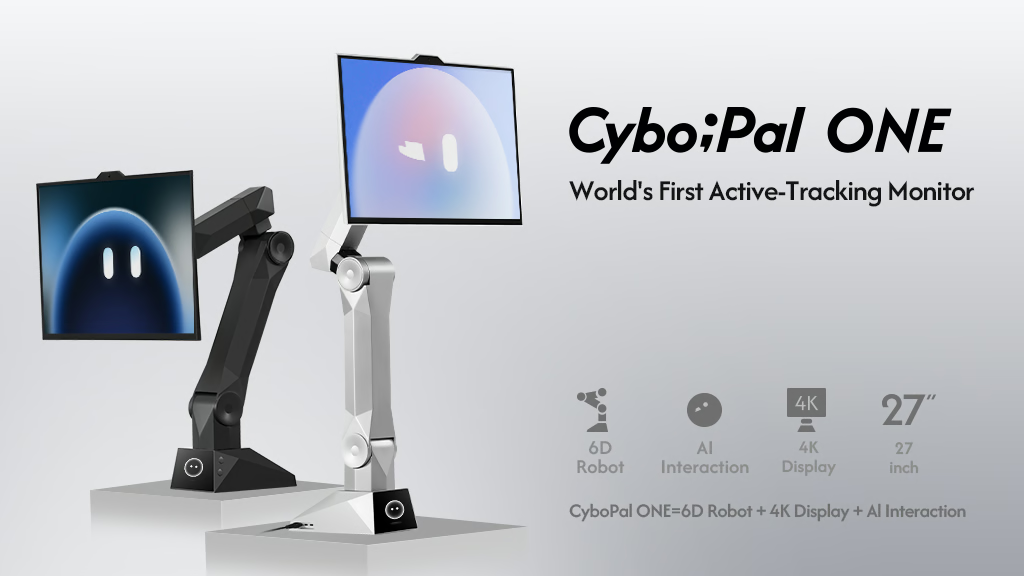
A crowdfunding campaign has been launched on Kickstarter for CyboPal One — a device its creators describe as the world’s first AI-native robotic monitor with active user posture tracking. The project is positioned not merely as a display, but as a full-fledged next-generation physical interface between humans and computers.
The concept of CyboPal One revolves around the idea of a “living” screen. The monitor is mounted on a robotic movable platform and can automatically adjust its position in space, adapting to the user’s posture. The system tracks body position, head tilt, and viewing distance, adjusting the height, angle, and direction of the display without manual input. The developers emphasize that there is no such thing as a perfect static posture: physiologically, humans need to shift position every 30–40 minutes. A traditional fixed monitor, in their view, disrupts the flow state — lean back or change posture, and focus is instantly lost.
CyboPal offers a different scenario: the screen literally follows the user, maintaining an optimal viewing angle. The creators promise up to eight hours of comfortable work without constant micro-adjustments. In theory, this should reduce strain on the neck and back, decrease eye fatigue, and help sustain concentration during long sessions.
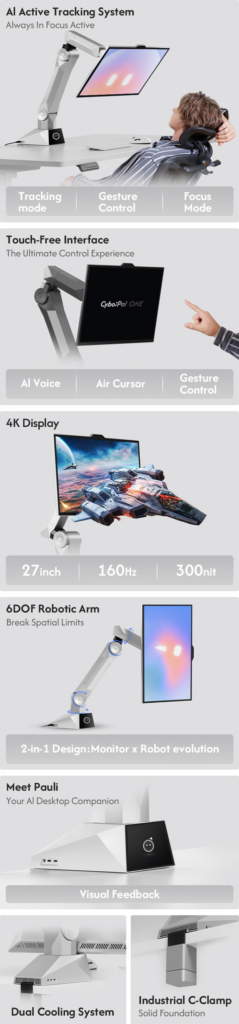
The second key feature of the device is deep artificial intelligence integration. CyboPal One is designed as an AI-native system: the user interacts not just with a screen, but with a voice interface that transforms spoken commands into actions on the computer. It integrates with installed AI agents capable of performing cross-application tasks: launching programs, processing data, managing files, generating documents, and automating repetitive operations.
According to the developers, delegating “cursor routine” to AI can save at least one hour of mechanical work per day. Over a year, that amounts to more than 260 hours — effectively several full working weeks freed up for creative or strategic tasks. The concept is built around reducing digital friction: fewer clicks, fewer window switches, fewer repetitive actions.
In this way, CyboPal One combines two major trends — the robotization of user interfaces and the widespread integration of AI agents into workflows. It represents an attempt to rethink the very model of computer interaction: instead of a static monitor and manual control, a movable display and voice commands; instead of clicking, automated scenarios.
The project is primarily aimed at developers, designers, content creators, analysts, and anyone who spends 6–10 hours a day at a computer. It may be especially appealing to so-called “vibe coders” — professionals who work closely with AI assistants and seek to minimize routine tasks while focusing on architecture, ideas, and creativity.
Questions remain regarding practical reliability, tracking precision, mechanical noise levels, and real-world integration with existing AI agents. Nevertheless, the emergence of such devices indicates that the market is gradually moving beyond software updates and beginning to reshape the physical form of the workspace itself.
The idea is ambitious: a robotic screen that moves with you, understands your voice, and takes over digital routine. The only question is whether it will become a new workplace standard or remain a striking yet niche experiment.
A video demonstration of the monitor in action can be viewed on our Telegram channel.
All content provided on this website (https://wildinwest.com/) -including attachments, links, or referenced materials — is for informative and entertainment purposes only and should not be considered as financial advice. Third-party materials remain the property of their respective owners.