


Coinbase ended the fourth quarter of 2025 on a clearly weak note, releasing a financial report that failed to meet Wall Street expectations and served as a worrying reminder of how strongly the cryptocurrency industry still depends on the market cycle.

The exchange posted its first net loss in two years, breaking a long streak of profitable quarters and reminding investors that even the sector’s largest players remain vulnerable when the market enters a cooling phase.
The main pressure came from declining trader activity amid falling digital asset prices. The crypto market experienced a painful correction at the end of 2025, hitting Coinbase’s core source of revenue – trading fees. The company reported a net loss of $667 million, an unexpected reversal after eight consecutive quarters of positive results. Earnings per share came in at $0.66, while analysts had expected around $0.92. Revenue declined 21.5% year over year to $1.78 billion, below the forecast of $1.85 billion, highlighting the scale of the slowdown.
The drop in transaction revenue was particularly telling. Coinbase has traditionally earned most of its income from trading commissions, and this segment took the hardest hit. Transaction revenue fell nearly 37% to $982.7 million. This reflects not only lower trading volumes but also a broader decline in retail investor interest, as many market participants prefer to stay on the sidelines during periods of uncertainty.

However, the report also contained more mixed – and in some areas even positive – elements. The subscriptions and services segment, which Coinbase has been actively developing as an alternative to trading fees, grew by more than 13% to $727.4 million. This category includes revenue from staking, custody services, subscription products, and infrastructure solutions. It partially offset the decline in trading activity and confirmed that Coinbase’s diversification strategy is working, even if it cannot fully shield the company from bearish market phases.
Coinbase’s weak performance coincided with a sharp downturn in the broader crypto market at the end of 2025. Bitcoin lost around 30% during the fourth quarter from its October peak of $126,000 and was trading below $88,500 by the end of December. The decline continued into early 2026, with the asset losing roughly a quarter of its value. Such market moves naturally lead to lower trading volumes, shrinking fee income, and weaker financial results across the industry, including the largest exchanges.
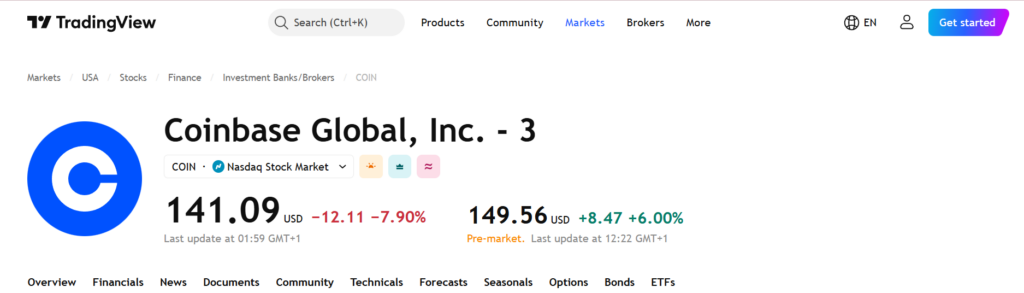
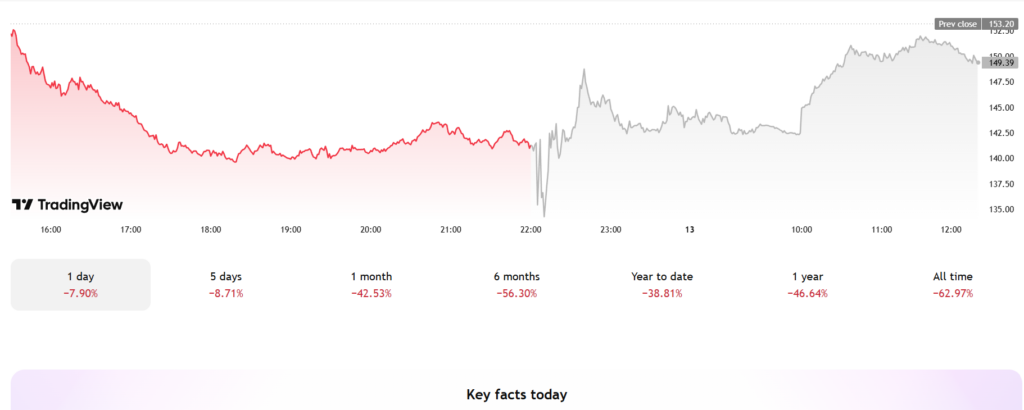
Still, investor reaction was unexpectedly calm. Despite the weak quarter, Coinbase shares rose 2.9% in after-hours trading to $145.2, following a drop during the regular session. This suggests the market had largely priced in the negative scenario and focused more on the company’s outlook and long-term trajectory than on the loss itself.
The forecast for early 2026 also looks mixed. Coinbase noted that as of February 10, transaction revenue in the current quarter stands at around $420 million, indicating continued weakness in trading activity. Moreover, subscriptions and services revenue may decline to a range of $550-630 million, showing that even more stable income streams are not immune to cyclical pressure.
At the same time, the exchange emphasized that 2025 was operationally strong overall. Annual revenue grew 9.4% to $6.88 billion. Coinbase also highlighted its central role in the global crypto ecosystem: more than 12% of all cryptocurrency worldwide is held on the platform. This figure demonstrates the scale of trust from users and institutional clients and reinforces Coinbase’s status as one of the industry’s key infrastructure players.
In the long term, the company is betting on expanding its product ecosystem, retaining customers, and transforming Coinbase into a universal financial gateway to digital assets rather than just a trading venue. Yet the fourth-quarter report makes one thing clear: as long as the crypto market remains volatile and sentiment-driven, the financial results of the largest exchanges will continue to fluctuate alongside the price of bitcoin.
The Coinbase story reflects the current state of the industry. Bear markets inevitably expose weaknesses in business models built on trading activity, while also forcing companies to accelerate the shift toward more sustainable sources of revenue. That is why Coinbase’s report looks not simply like a weak quarter, but like another stage in the crypto market’s maturation – gradually evolving from a speculative arena into a full-scale financial infrastructure through painful cycles of cleansing and restructuring.
A video review of the quarter from Coinbase’s CEO, published on the exchange’s official X account, can be viewed in our Telegram channel.
All content provided on this website (https://wildinwest.com/) -including attachments, links, or referenced materials — is for informative and entertainment purposes only and should not be considered as financial advice. Third-party materials remain the property of their respective owners.