


Robinhood is showing a significant decline following its financial report, and the reason is far from losses—it stems from decreased user activity and lower revenue from its cryptocurrency segment. The company missed revenue expectations for the fourth quarter, primarily due to a cooling retail market and a sharp drop in interest in trading digital assets. Crypto revenue fell 38% year-over-year, totaling $221 million, despite the platform actively expanding its list of tokens and crypto-related features.
This demonstrates that even efforts to diversify the crypto portfolio and improve user experience have so far failed to offset the negative impact of market fluctuations.
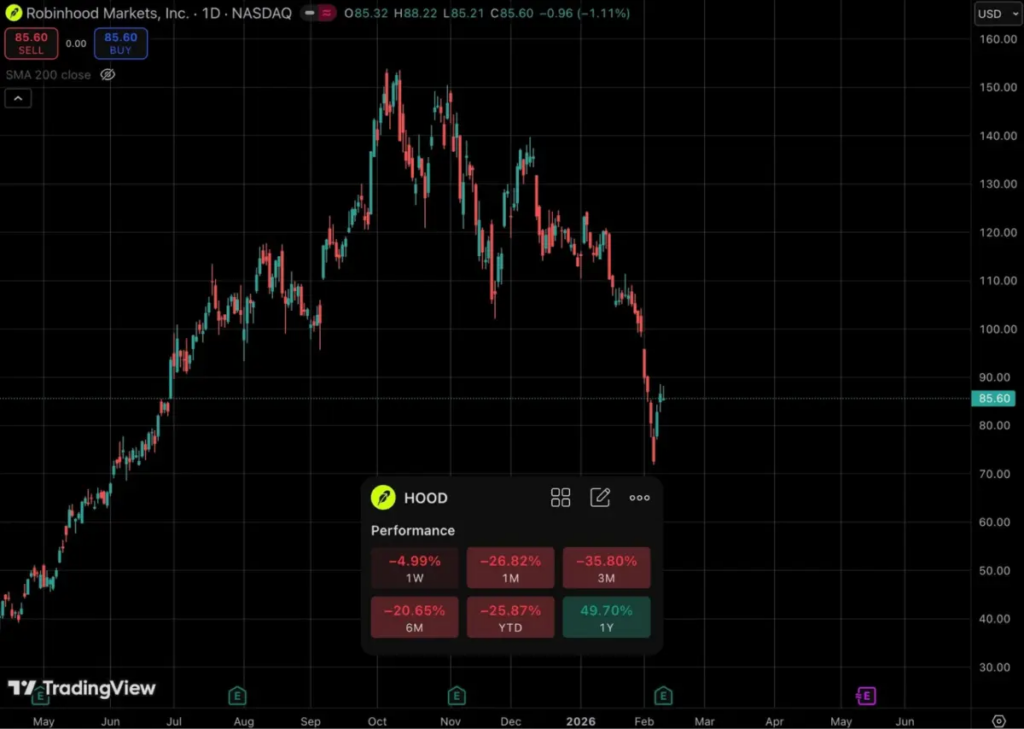
Nevertheless, Robinhood has some positive aspects: Gold subscriptions are growing, client assets continue to increase, and options remain a popular tool, showing stable growth. In this sense, HOOD shares reflect the sentiment of the retail speculative market: when retail interest returns, prices could rebound just as quickly as they fell.
Over the past year, Robinhood has significantly developed its crypto features, expanded its token offering, and allowed users to make crypto transfers across more regions, making the platform more versatile and transforming it from a simple trading app into a full gateway into digital assets. Despite this, the market dictates the rules: falling prices reduce trading activity, especially among retail clients, who provide the majority of the platform’s volume.
The decline in crypto performance contrasts with Robinhood’s broader business structure. Total revenue reached $776 million, up 15% year-over-year. Increased activity in stock and options trading helped offset the drop in crypto revenue, indicating a more balanced profit structure compared with previous cycles. The company reported earnings per share (EPS) of $0.66 for the second quarter, surpassing Wall Street’s forecast of $0.63, though total revenue of $1.28 billion fell short of the expected $1.33 billion.
After the report, Robinhood shares fell 7.7% in after-hours trading, continuing a decline that began around the time of the crypto peak in early October 2025. Currently, shares are trading around $79, nearly 50% below their all-time high.
A similar situation is seen with competitor Coinbase, which is set to release its financial results on Thursday. Analysts expect lower trading volumes and weaker revenues, reflecting the same market conditions that negatively impacted Robinhood’s crypto business. After HOOD’s results, COIN shares fell 1.6% in after-hours trading, showing that the current crypto market volatility affects the entire sector.

Overall, the current situation with Robinhood is a clear example of how the retail market and cryptocurrency segment remain highly sensitive to demand cycles and price swings. For investors, this is more of a volatile cycle play than a calm, stable long-term investment, requiring patience and readiness for sharp price fluctuations.
All content provided on this website (https://wildinwest.com/) -including attachments, links, or referenced materials — is for informative and entertainment purposes only and should not be considered as financial advice. Third-party materials remain the property of their respective owners.