

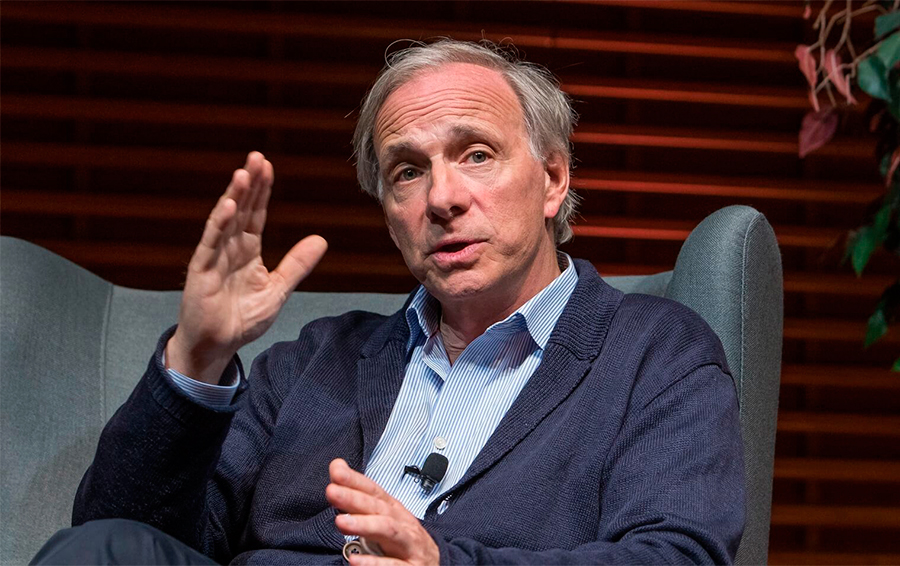
Ray Dalio, billionaire and founder of Bridgewater Associates, is once again saying what investors don’t really like to hear over their morning coffee: the world is entering a rare historical moment when several supporting structures of the global order are breaking at the same time. And this is not about a local crisis, not about temporary turbulence, and not even about “a difficult year.” According to him, we are witnessing a systemic turning point – simultaneously monetary, political, and geopolitical.
Dalio describes what is happening not as chaos, but as a recurring historical cycle. For many years, he has studied how empires rise and fall, how reserve currencies change, and how states pass through peaks of strength and inevitable stages of weakening. His conclusion is rather cold: the United States remains the most powerful country, but it is already in the second-to-last stage of decline before a full-scale crisis of the system. This does not mean an immediate collapse tomorrow morning, but it does mean that fundamental mechanisms are beginning to work differently than in an era of stability.
The main point of tension, according to Dalio, is fiat money and the debt model. Any paper monetary system built on trust and obligations eventually accumulates too much debt. Governments spend more than they collect, political incentives always push toward new promises, and the debt burden becomes chronic. And at some point, the choice becomes very simple: default or the printing press. History shows that authorities almost always choose the second, because default is an instant political catastrophe, while inflation looks like a more “gentle” way to shift the cost of the crisis onto everyone at once.
Dalio emphasizes that the problem is not only in the debt numbers, but in trust in the system itself. When money can be created in unlimited volume, people begin to ask: what exactly am I holding in my hands – value or a promise? And the more a state depends on issuance, the more that promise gets diluted.
A separate layer of his analysis is connected to the dollar. Dalio believes that the role of the dollar as an unconditional global anchor is gradually weakening. The reason is not only economic, but also geopolitical. Sanctions, the use of the financial system as a tool of pressure, and growing competition between blocs – all of this pushes countries to look for alternatives. When a reserve currency turns not simply into a means of settlement but into a lever of control, others begin to think about protection.
And it is precisely here that one of the most visible signals of the era appears: central banks around the world are actively accumulating gold. For Dalio, this is not romanticism of the past and not nostalgia for the gold standard, but a pragmatic reaction to fiat risks. Gold does not promise returns, but it is not anyone’s liability. It cannot be “printed,” it does not depend on a political decision, and that is why, in moments when trust in paper money declines, interest in it grows.
In essence, Dalio is talking about a world where trust becomes the main scarcity. If the twentieth century was the era of strengthening the dollar system and globalization under a single financial center, then the twenty-first century may become the era of the breakdown of a single monetary order into several competing models. In such an environment, the role of “hard” assets grows – everything that is perceived as protection against inflation, devaluation, and political risks.
This does not mean that tomorrow everyone will run to exchange dollars for bullion. But it does mean that the very logic of accumulating and preserving capital is changing. The world is entering a phase where stability is no longer perceived as the default setting of the system, but becomes a rare resource.
Dalio, as always, does not propose panic. He proposes looking at what is happening soberly: large cycles unfold slowly, but they almost always end the same way – with a redistribution of power, a change in financial rules, and a revaluation of what people consider real money.
And if his model is correct, then we truly stand on the threshold of a world where fiat will lose its monopoly on trust, and the “hardness” of assets will once again become a key factor in the survival of capital.
All content provided on this website (https://wildinwest.com/) -including attachments, links, or referenced materials — is for informative and entertainment purposes only and should not be considered as financial advice. Third-party materials remain the property of their respective owners.