


The Japanese company Metaplanet will continue to buy Bitcoin even amid a massive cryptocurrency market sell-off. Despite one of the harshest corrections in recent years, the company’s management has stated that it does not intend to change its strategy for accumulating the leading cryptocurrency.
On February 6, Metaplanet CEO Simon Gerovich wrote on X that the company’s course remains unchanged. “Metaplanet’s strategy is unchanged. We will steadily continue accumulating Bitcoin, expanding revenues, and preparing for the next phase of growth,” he emphasized.


The statement came at a time when the market was gripped by panic and investor confidence was being tested. Bitcoin is falling, altcoins are hitting new lows, liquidations are occurring in waves, and more participants are asking whether the era of corporate optimism around cryptocurrencies has ended.
Nevertheless, Metaplanet shows complete calm, as if the crypto market were not a storm but a typical Japanese autumn. The stock market, however, reacts less philosophically. Metaplanet shares on the Tokyo Stock Exchange closed on February 6 down 5.56% to 340 yen (about $2.16). Investors are clearly nervous: when a company’s on-balance-sheet asset loses tens of percent, even the most confident statements about long-term strategy sound less persuasive.
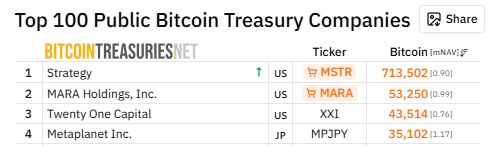
Metaplanet remains one of the largest corporate Bitcoin holders in the world. According to BitcoinTreasuries.NET, the company owns 35,102 BTC, ranking fourth among publicly traded companies, behind only Strategy, MARA Holdings, and Twenty One Capital. This makes the Japanese firm not just a market participant but a full-fledged player in the corporate “whale” category.
Corporate whales are not feeling their best at the moment. The crypto market is undergoing a correction that many call the heaviest since 2022. Bitcoin has fallen 52.5% from its all-time high of $126,080 set in October 2025. The Crypto Fear & Greed Index has dropped to its lowest levels since the Terra Luna crash in May 2022.
Panic is amplified by the derivatives market. On February 5 alone, according to Coinglass, long positions worth $1.844 billion were liquidated. This means traders were literally forced out of deals automatically: prices fell, margin calls were triggered, positions closed, selling intensified, and a new wave of declines began. Classic crypto dominoes, only this time the scale is particularly painful.
Corporate Bitcoin holders are now recording losses not just emotionally, but on their balance sheets.
Strategy, the largest public BTC holder, reported a net loss of $12.4 billion for Q4 2025. The reason is simple: Bitcoin fell below the company’s average purchase price of $76,052. After the report, Strategy shares plunged 17%, though management tried to reassure the market that the company’s capital structure remains stable and major debt payments are not due until 2027.
Yet even Strategy is not stopping. According to a February 2 report, the company purchased an additional 855 BTC for roughly $75 million. This is no longer an investment but an ideology: buy always, even when it hurts.
Metaplanet is following the same path. The company has not signaled any desire to reduce exposure or sell part of its reserves. Yet the numbers speak for themselves: the average Bitcoin cost in Metaplanet’s portfolio is $107,716. This means the Japanese corporate holder is also in a zone of significant unrealized losses.
Other companies using cryptocurrency as a treasury asset are also under pressure. For example, Bitmine owns 1.17 million Ethereum and already has unrealized losses exceeding $8.25 billion. The problem is thus broader than just Bitcoin: the entire corporate crypto-reserve model is facing the reality of a bear market.
Today’s situation is a stress test for the entire industry. Companies that looked like visionaries in a bull market now have to prove that their strategy is not speculation, but a truly long-term course.
Analysts note that this concentration is unprecedented: private companies have never before controlled such a share of Bitcoin in corporate reserves. Strategy controls more than 3.4% of the fixed supply of 21 million coins. This creates a new form of centralization that contradicts the very philosophy of decentralized cryptocurrency.
Financing models through debt issuance and shareholder dilution only work in a rising market. The current correction exposes vulnerabilities: if the decline continues, pressure from investors, creditors, and regulators could become critical.
Machine analysis of historical cycles shows that corporate whales have never faced a full bear market with such volumes. If even one major holder starts reducing positions, it could trigger a domino effect that amplifies volatility.
The key question today is not, “Will companies sell their Bitcoin?” The key question is: will they physically be able to avoid selling if the decline continues long enough. Metaplanet currently answers confidently: yes, they can. But the market, as always, likes to test such statements in practice.
All content provided on this website (https://wildinwest.com/) -including attachments, links, or referenced materials — is for informative and entertainment purposes only and should not be considered as financial advice. Third-party materials remain the property of their respective owners.