


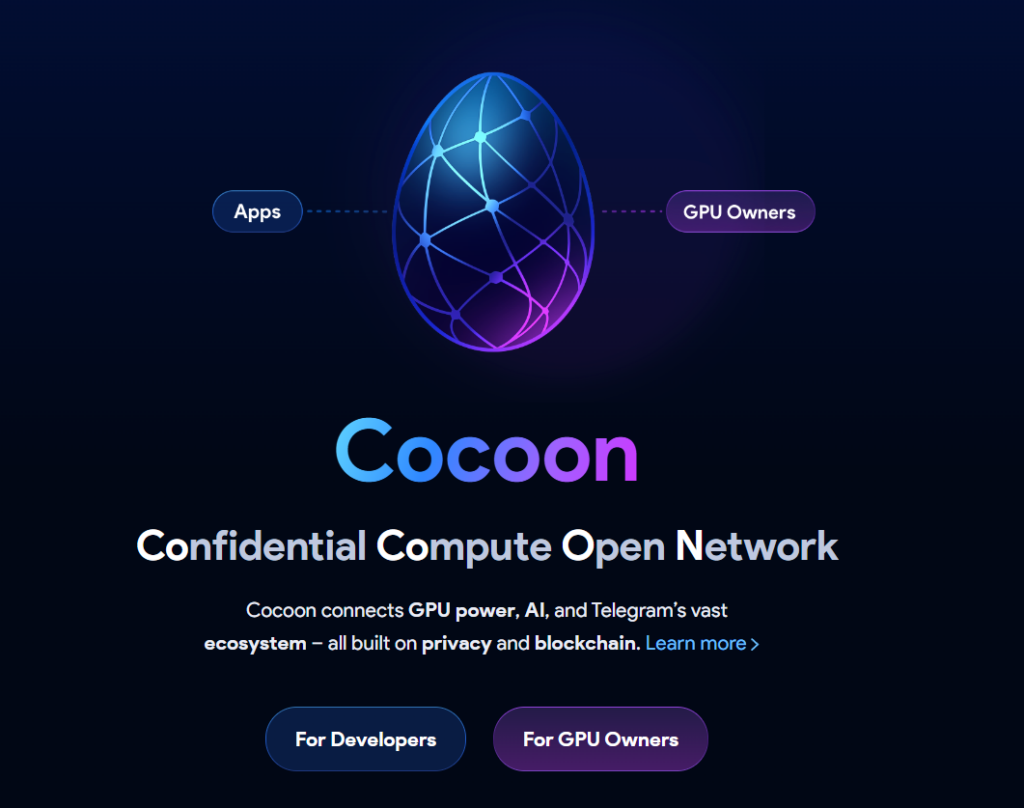
Telegram has made, by industry standards, a rather sharp and principled move by launching its own decentralized computing network, Cocoon (Confidential Compute Open Network). This is not just another AI service within the messenger but an attempt to rethink who owns computation and user data in the era of mass AI adoption.
The key feature of Cocoon is that AI requests are processed inside secure enclaves — isolated memory areas where data remains encrypted not only during transmission and storage but also during computation. Even during processing, models do not have “transparent” access to the content of the requests. This fundamentally distinguishes Cocoon from classic cloud AI services, where the provider can technically view or analyze user data.
The launch of Cocoon was effectively a direct result of the failed negotiations between Telegram and Elon Musk’s xAI about a potential integration of Grok into the messenger.
Why the xAI Deal Fell Through
According to publicly available information, the discussed deal looked extremely generous. xAI offered Telegram about $300 million in cash and equity, plus 50% of xAI subscription revenues generated through Telegram. For most companies, this would have appeared as an obvious win, but Pavel Durov chose to decline.
conference in Dubai, Durov spoke strongly about the risks of centralized AI. His position was simple: computation and data should belong to users, not corporations or governments.

Centralized AI providers inherently have potential access to user data, which can be used to retrain models, profile behavior, target users, or even manipulate subtly. For Telegram, which has long built its reputation as a privacy-focused messenger, such a compromise seemed too risky.
After the first leaks appeared, Musk denied finalizing the deal, and since then, neither side has publicly revisited the topic. However, the launch of Cocoon effectively drew a line under the matter, showing that Telegram chose its own path.
Cocoon Architecture and Operating Principles Cocoon is built on The Open Network (TON) blockchain and uses Trusted Execution Environments (TEE) technology. This means computations are performed in a hardware-protected environment where even the GPU owner or node operator cannot see exactly which data is being processed.
The user request, the model, and the computation result exist inside the enclave in encrypted form. No data center administrator, hardware provider, or Telegram itself has access to the contents. Architecturally, this is an attempt to implement a “zero trust” principle at the computation level.
The network’s economic model is also decentralized. GPU owners worldwide can join the network, provide computing resources, and receive rewards in TON for tasks completed. This turns Cocoon into a global AI computing marketplace, where supply and demand are formed not by a single cloud provider but by the entire ecosystem.
For developers of Telegram apps and mini-apps, this means access to AI resources at lower costs than centralized clouds, with an additional privacy advantage, increasingly important to users.
Telegram itself has already become the largest client of its network. A number of built-in AI features, including message translation, voice-to-text conversion, AI summaries of long channel posts, and Instant View, are partially or entirely running on Cocoon. This is not an experiment in a vacuum but real load with millions of users.
Practical Use and Early Results In the January 8, 2026 Telegram update, the AI Summary feature for long channel posts and Instant View articles was introduced. Summaries are generated using open-source models running inside Cocoon. This is significant: Telegram bets not only on decentralizing infrastructure but also on using open-source models, reducing dependency on closed ecosystems.
The project is open-source, available on GitHub, allowing independent developers and researchers to analyze the architecture and contribute to network development. In the coming weeks, the team plans to connect more GPU nodes and actively involve developers, expanding the ecosystem and the set of AI features within Telegram.
Strategically, this looks like an attempt to transform the messenger into a full-fledged platform, where AI is integrated but controlled by the user, rather than an external service with opaque rules.
AI Opinion and Market Context The history of decentralized computing networks has many examples where good ideas hit the “cold start” problem. Projects like Golem, iExec, or Akash Network struggled for years to balance supply and demand, facing the challenge that without users, GPU providers do not come, and without computing power, users do not come.
Cocoon solves this problem cleverly. From day one, Telegram acts as the largest consumer of its own network, creating guaranteed demand for computations. This sharply lowers the entry barrier for GPU owners and makes the network economy more resilient at an early stage.
Deployment speed is also unusually high for decentralized projects. From the public announcement in November 2025 to full AI Summary integration in January 2026, less than three months passed. For comparison, most similar networks take years to reach real mass adoption.
The main open question remains: can the team maintain such speed and quality when scaling to thousands, potentially tens of thousands of GPU nodes? If so, Cocoon could become one of the first successful examples of decentralized AI infrastructure with a real user base, not just polished presentations.
All content provided on this website (https://wildinwest.com/) -including attachments, links, or referenced materials — is for informative and entertainment purposes only and should not be considered as financial advice. Third-party materials remain the property of their respective owners.