

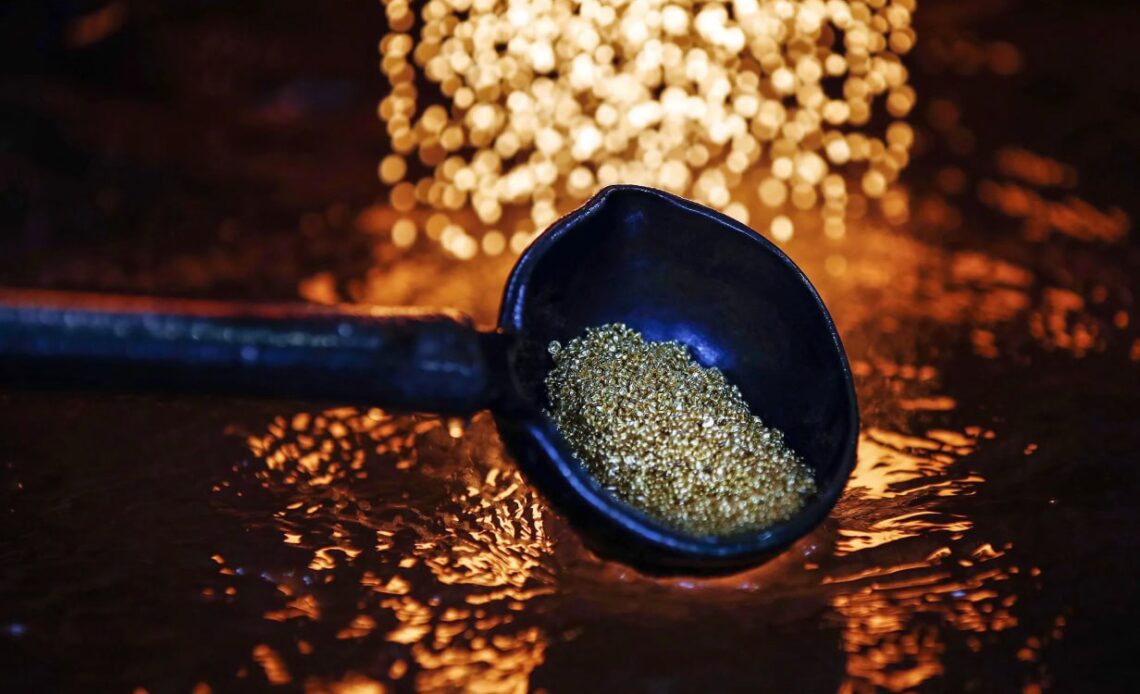
Tether, the issuer of the world’s largest stablecoin USDT, has quietly transformed itself into one of the most influential players in the global gold market. According to Bloomberg, Tether has already accumulated around 140 tons of physical gold with a total value of approximately $23 billion and continues to actively build its reserves, purchasing an average of 1-2 tons per week.
For comparison, over the past year Tether acquired more than 70 tons of gold. That is more than nearly all of the world’s central banks purchased over the same period. The only notable exception is Poland, which added 102 tons to its reserves, demonstrating a classic state-level approach to protecting national assets. Against this backdrop, all other regulators look far more modest.
It is important to emphasize that this is not about paper derivatives or exchange-traded funds, but about physical gold. The bars are stored in Switzerland, in a specially equipped former nuclear bunker with a multi-layered security system. This is not a marketing metaphor, but a literal description of the storage infrastructure. The old, well-known principle applies here: if something is truly valuable, it is hidden deep and protected seriously.
CEO Paolo Ardoino openly states that Tether is effectively becoming one of the world’s largest “gold central banks” – albeit without a flag, an anthem, or a parliament. And there is little exaggeration in this statement. By the size of its holdings, Tether is already comparable to the state reserves of mid-sized countries and surpasses most private financial institutions.

Why does this matter? Because Tether is not just a company, but an infrastructure element of the crypto market. USDT is used as a unit of account, a tool for preserving liquidity, and a temporary safe haven for capital for millions of users around the world. When an issuer of this scale bets not only on dollar-denominated assets but also on gold, it sends a clear signal to the market: the era of unconditional trust in fiat currencies is gradually coming to an end.
In effect, we are witnessing a paradoxical picture. On one side, there is a digital stablecoin – a symbol of a new financial era. On the other, physical gold – the most conservative asset imaginable. And it is precisely their combination that forms the foundation of Tether’s strategy. No romance, only cold calculation: gold does not depend on interest rates, sanctions, Federal Reserve decisions, or political cycles.
Against the backdrop of a weakening dollar, rising geopolitical risks, and record budget deficits, such a strategy looks less like an exotic experiment and more like a return to financial fundamentals. The only difference is that in the past gold was accumulated by states, whereas today it is being accumulated by a private company with a global digital product.
The irony of the moment is that while central banks are discussing digital currencies of the future, a crypto company is already building its own gold standard. Without slogans, but with a bunker, gold bars, and regular deliveries.
All content provided on this website (https://wildinwest.com/) -including attachments, links, or referenced materials — is for informative and entertainment purposes only and should not be considered as financial advice. Third-party materials remain the property of their respective owners.