


Researchers at the University of California, Irvine (UC Irvine) have developed a unique wireless transceiver capable of transmitting data through the air at speeds up to 120 Gbps — approximately 15 gigabytes per second. For comparison, the theoretical limit of Wi-Fi 7 is around 30 Gbps, and 5G mmWave reaches up to 5 Gbps. In other words, this new technology provides speeds comparable to the bandwidth of most fiber-optic lines used today in data centers and commercial networks (around 100 Gbps).
The chip operates at ultra-high radio frequencies around 140 GHz — a range already being considered by regulators and 6G standards developers as the next step in communication technology. The main purpose of this technology is to provide ultra-fast connectivity where cables cannot be used, such as in data centers, industrial robots, autonomous systems, and future sixth-generation networks.
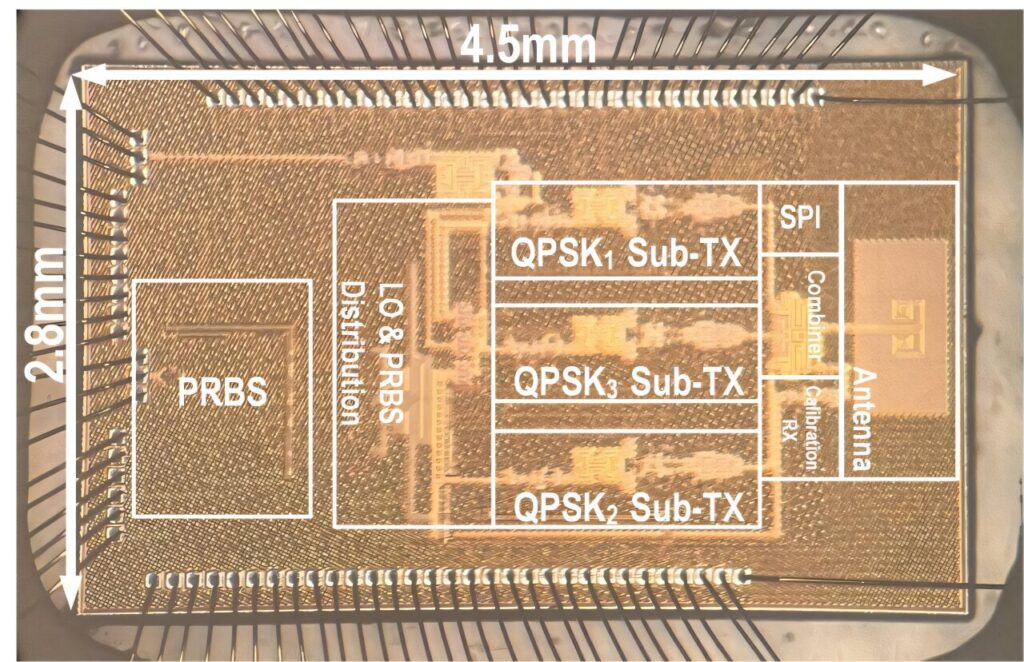
The problem with conventional solutions
Traditional transmitters using digital-to-analog converters (DACs) face serious limitations at these speeds. Achieving 120 Gbps requires extremely complex DACs that consume several watts of power — too much for mobile devices or compact systems. This creates a so-called DAC bottleneck: the power, size, and complexity make such solutions impractical.
UC Irvine’s innovative approach
The UC Irvine team found an elegant solution. Instead of using a single high-power digital converter, they employed three synchronized sub-transmitters. This approach reduced power consumption to just 230 milliwatts — tens of times less than a conventional DAC operating at the same speed. Payam Heydari, head of UC Irvine’s Nano-Communications Integrated Circuits Lab, notes: “Switching to analog computation instead of ‘hungry’ digital solutions dramatically improves energy efficiency and simplifies the chip architecture.”
Furthermore, the chip is fabricated using a 22-nm FD-SOI process, which is simpler and cheaper to produce compared to advanced 2-nm or 18A nodes used by TSMC and Samsung. This increases the chances for mass adoption, making the technology accessible not only to research labs but also to commercial equipment manufacturers.
Prospects and applications
Researchers believe their solution could become a real alternative to kilometers of cabling in data centers, significantly reducing infrastructure, installation, and maintenance costs. Instead of massive fiber-optic lines, wireless channels with comparable bandwidth can be used.
The technology also opens new opportunities for robotics and 6G mobile networks. High transmission speeds and low power consumption enable autonomous systems where cabling is impossible or inconvenient. In the future, such chips could be used in smart cities, industrial automated complexes, virtual and augmented reality systems, and for transferring large volumes of data between data centers without physical cables.
Overall, UC Irvine’s development demonstrates that the future of wireless communications could reach fiber-optic speeds with significantly lower energy and infrastructure costs. Advances in ultra-high-frequency technology open new horizons for data centers, industrial networks, and 6G, bringing wireless connectivity closer to limits previously thought achievable only with cable solutions.
All content provided on this website (https://wildinwest.com/) -including attachments, links, or referenced materials — is for informative and entertainment purposes only and should not be considered as financial advice. Third-party materials remain the property of their respective owners.