

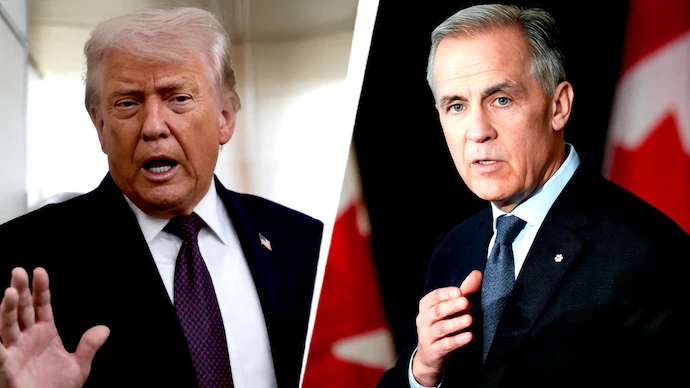
Donald Trump sharply escalated the trade agenda, stating that if Canada signs a trade deal with China, the U.S. will impose 100% tariffs on all Canadian goods shipped to the American market. The statement was not made as a diplomatic warning, but in Trump’s usual ultimatum style – via Truth Social.
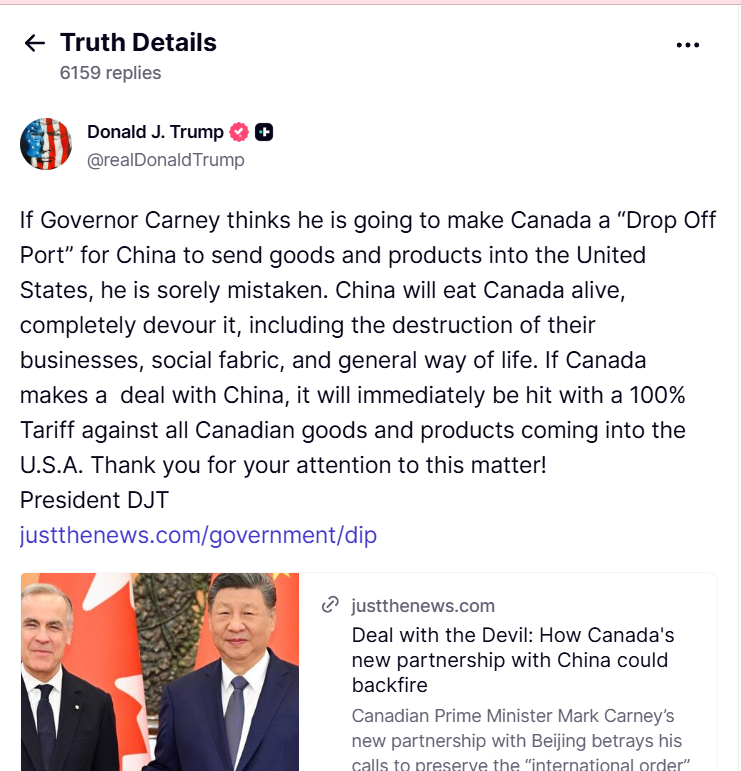
According to Trump, Canada is “seriously mistaken” in allowing China to increase imports, especially in the sensitive electric vehicle sector. In his phrasing, the threat sounds almost apocalyptic: China, in the U.S. president’s view, will “devour Canada alive,” destroying its business, social structure, and way of life. If Ottawa proceeds with a deal with Beijing, the response will be immediate – 100% tariffs on all Canadian exports to the U.S.
Particular attention is drawn to the tone Trump uses when referring to Canadian leadership. He deliberately calls Prime Minister Mark Carney a “governor,” clearly implying Canada’s subordinate position relative to the U.S. In the same post, Trump warns: if Carney expects to turn Canada into a “transit point” for Chinese goods on their way to the American market, he “is gravely mistaken.”
And this is where it gets interesting.
Just eight days ago, Trump publicly stated the exact opposite: if Canada wants to sign a trade deal with China – that is its right, let them do it. No threats, no ultimatums. Now, however, there’s a sharp 180-degree turn and maximum pressure.
This behavior appears less as a contradiction and more as classic Trump tactics. First, the illusion of freedom of choice is created, then the stakes are sharply raised and a strict condition imposed. This is not diplomacy in the usual sense, but negotiation through shock and uncertainty.
In a broader context, this is less about Canada and more about China and control over supply chains. The U.S. is increasingly reacting harshly to any attempt by allies to integrate into China’s industrial and trade ecosystem, especially in strategic sectors – electric vehicles, batteries, green energy. In this logic, Canada is viewed not as an independent player but as a potential “gap” in U.S. trade barriers.
For Canada, the situation is extremely uncomfortable. The country’s economy is critically tied to the American market, and the threat of 100% tariffs is effectively economic warfare. At the same time, China remains an important trading partner and source of investment. Any decision will come at a high cost.
From a cold perspective, this is not an impulsive tweet but a signal: the era of neutral maneuvering for U.S. allies is ending. Either you operate within the American trade framework and play by its rules, or you face severe consequences.
And the “multi-step strategy” is quite clear here. Trump is testing the limits of partners’ loyalty while simultaneously sending a signal to markets, China, and his own electorate: there will be no compromises, control will be strict, and the rules unilateral. The question is only how far he is willing to go and who will blink first.
A video clip of Trump’s statement is available on our Telegram channel.
All content provided on this website (https://wildinwest.com/) -including attachments, links, or referenced materials — is for informative and entertainment purposes only and should not be considered as financial advice. Third-party materials remain the property of their respective owners.