


Panic in the Japanese bond market is gradually ceasing to be a local story and is beginning to affect global markets, including cryptocurrencies. What until recently seemed like a dull topic for debt market specialists has suddenly become one of the key sources of pressure on risk assets.
Yields on 30-year Japanese government bonds have jumped close to 4% – the highest level in 27 years. For a country that spent decades living with zero and even negative interest rates, such yields look like a true tectonic shift. The Japanese bond market was long seen as a symbol of stability and predictability, but it is now becoming a source of turbulence.
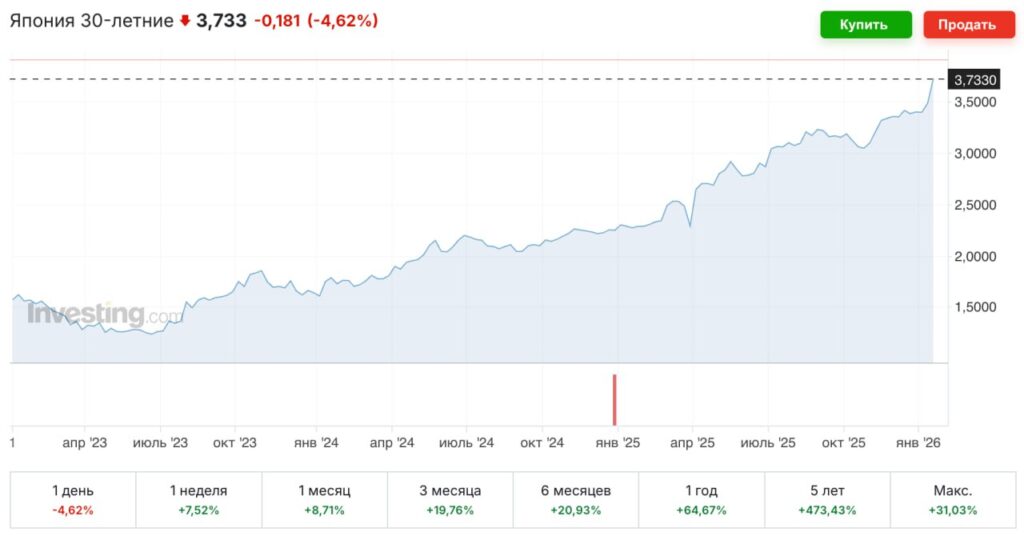
The core problem is the breakdown of one of the most resilient global financial schemes of recent decades. This is the so-called yen carry trade. For years, investors around the world borrowed money in yen at minimal interest rates and deployed that capital into higher-yielding and riskier assets: U.S. equities, emerging markets, real estate, venture capital, and cryptocurrencies. Cheap yen effectively served as fuel for the global appetite for risk.
Now this model is cracking. Rising yields on Japanese bonds mean that capital inside Japan no longer looks “idle”. Money is starting to flow back home, as returns become attractive even without currency or market risk. For global markets, this means the loss of one of the most reliable sources of liquidity.
The effect spreads through a chain reaction. Investors are forced to close positions, reduce leverage, and pull funds out of risk assets. Equity markets come under pressure, especially the technology sector. Gold and silver are hitting new highs, confirming a classic shift into safe-haven assets. Bitcoin, despite its reputation as “digital gold”, behaves like a risk asset in such phases and falls alongside other markets.
It is important to understand that this is not a story about weakness in Bitcoin as a technology. It is a story about global capital flows. When liquidity tightens, everything that can be sold quickly and without constraints gets sold. In this sense, the crypto market is one of the most convenient targets for risk reduction.
Additional nervousness comes from expectations around the Bank of Japan’s upcoming interest rate decision. Formally, markets are pricing in a pause, but right now the rhetoric matters more than the numbers themselves. Any hints at further tightening or a willingness to tolerate rising yields could intensify capital outflows and pressure on risk assets, including cryptocurrencies.

In a broader context, Japan’s situation may become a turning point for the entire global financial system. If the country fully exits the era of ultra-cheap money, the world will lose the last “anchor” of ultra-loose monetary policy. This implies a higher cost of capital, lower tolerance for risk, and a reassessment of asset valuations that have risen for years on the back of excess liquidity.
For the crypto market, this is a painful but important test. In the short term, pressure may persist, especially if yields continue to rise. In the long term, the market once again faces an old question: what will drive the next cycle – a new wave of liquidity or the ability of the crypto economy to function in a world of expensive money.
For now, the answer is unclear. But one thing is certain: events in Japan have stopped being an exotic curiosity and have become a factor that investors around the world can no longer ignore.
All content provided on this website (https://wildinwest.com/) -including attachments, links, or referenced materials — is for informative and entertainment purposes only and should not be considered as financial advice. Third-party materials remain the property of their respective owners.