


The New York Stock Exchange is taking one of the most illustrative steps in its entire history and effectively acknowledging that the future of capital markets will be digital, round-the-clock, and closely tied to blockchain infrastructure. NYSE has officially announced the development of a new platform for trading and on-chain settlement of tokenized securities. The launch of the project directly depends on regulatory approval, but the very wording of the initiative already signals a shift in paradigm – this is not an experiment in a “sandbox”, but a full-fledged market infrastructure.
The core idea of the platform is to remove the main limitations of the traditional stock market. Trading will be available 24 hours a day, without attachment to trading sessions or banking schedules. Trade settlements are planned to be executed almost instantly, without the usual T+1 or T+2 delays. At the same time, participants will be able to place orders in US dollar terms, removing the barrier between traditional financial systems and digital assets. To provide liquidity and fund operations, support for stablecoins is предусмотрена, which will effectively become the settlement layer of the new venue.
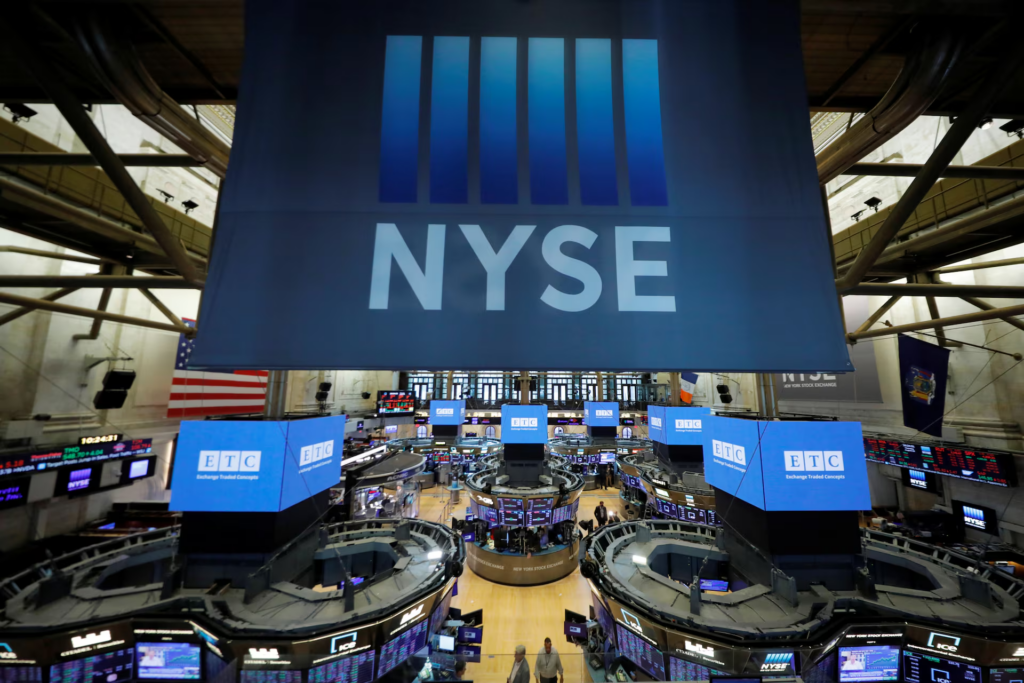
From a technical perspective, the project appears particularly ambitious. The platform will combine the time-tested NYSE Pillar matching engine, which currently handles enormous order volumes on the US equity market, with blockchain-based post-trade systems. This means that order matching will remain in a familiar, low-latency environment for institutional players, while settlements and ownership record-keeping will be moved to distributed ledgers. The platform’s architecture is being designed as multi-network from the outset, allowing settlements across different blockchains depending on regulatory requirements, asset types, and participant needs.
In terms of products, the exchange is not limiting itself to merely “digitizing” existing equities. The platform will operate with both tokenized securities that are fully interchangeable with traditional stocks and bonds, and native digital assets originally issued on the blockchain. Token holders will retain all economic and corporate rights, including the receipt of dividends and participation in corporate governance. This is a crucial point, as it addresses one of investors’ main concerns – the loss of a legal link between the token and the underlying real-world asset.
Access to the system will be granted to qualified broker-dealers, underscoring the institutional nature of the project. NYSE is not betting on retail hype or a mass influx of unqualified investors. On the contrary, the exchange is building infrastructure designed for professional market participants, banks, funds, and large asset managers, for whom reliability, compliance, and legal certainty are paramount.
The exchange’s parent company, Intercontinental Exchange, is simultaneously carrying out extensive work to adapt clearing and settlement infrastructure to a 24/7 operating mode. In partnership with banks BNY and Citi, the group is implementing support for tokenized deposits, enabling market participants to manage margin, collateral, and liquidity outside standard banking hours. In effect, this represents the creation of a new layer of monetary circulation that will operate in sync with on-chain markets rather than slowing them down due to the constraints of the traditional banking system.
NYSE President Lynn Martin emphasized that the exchange’s goal is to combine the trust accumulated over decades in traditional markets with modern on-chain solutions, without sacrificing investor protection standards. This is an important signal for the entire industry: the world’s largest exchanges no longer view blockchain as a threat or an exotic novelty, but are integrating it into the core of financial infrastructure.
In a broader context, NYSE’s initiative appears as a logical continuation of the institutionalization of the crypto market and the tokenization of real-world assets. If the project receives regulatory approval and is successfully launched, it could become a turning point for the entire industry, where the boundary between traditional finance and digital assets will finally cease to be rigid. The market is gradually returning to an old truth, albeit in a new technological form: money values speed, reliability, and clear rules, and everything else is only a matter of time.
All content provided on this website (https://wildinwest.com/) -including attachments, links, or referenced materials — is for informative and entertainment purposes only and should not be considered as financial advice. Third-party materials remain the property of their respective owners.