

Tether has proposed introducing the term “Scudo” as a new unit of account for its gold-backed stablecoin XAUT. One scudo will be equal to 1/1000 of a troy ounce of gold. The idea looks simple, but behind it lies a fairly ambitious attempt to restore gold’s lost payment function and adapt it to the digital economy.
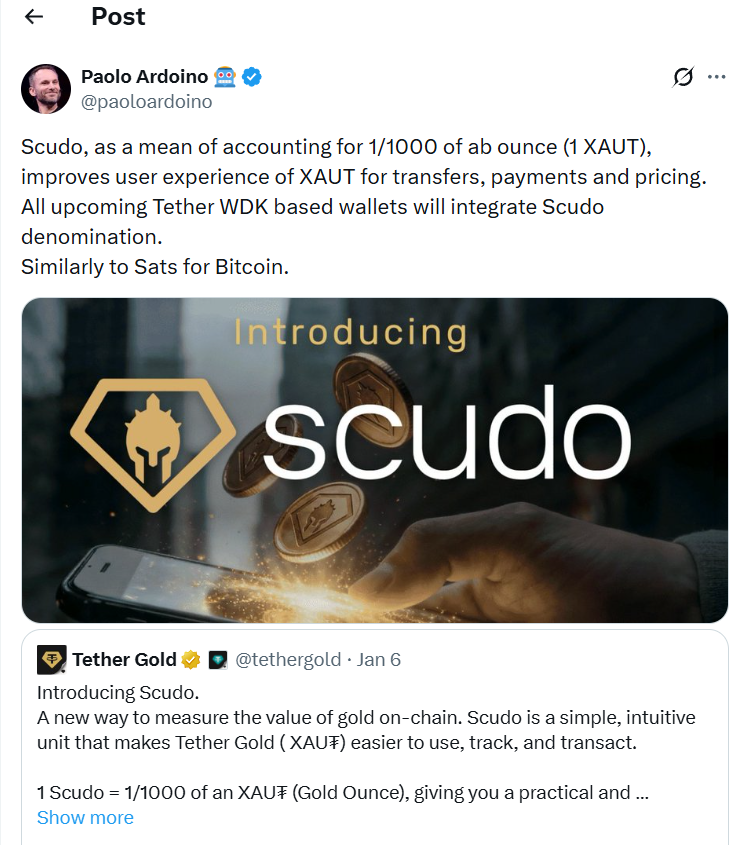
Today, gold is mainly used as a store of value and an inflation hedge, but it is almost never used in everyday payments. The reason is straightforward: inconvenience. The price of one ounce is too high, and operating with fractional values such as 0.0037 XAUT is poorly suited for paying for goods and services. The introduction of scudo solves this problem by turning gold into a more “readable” and convenient unit of account. Essentially, this is the same logical step as the emergence of satoshis for Bitcoin: when the base unit is too large, the market naturally divides it into a more practical scale.
Tether explicitly states that the growing interest in gold as a means of preserving purchasing power creates an opportunity to revive its use as money. Before the era of fiat currencies, gold served this role for centuries — as a universal equivalent of value, independent of government and central bank decisions. The shift to fiat made transactions more convenient but stripped money of its hard link to real assets. Blockchain technology now makes it possible to combine both worlds: the stability of gold and the convenience of digital payments.
Scudo as a unit of account enables pricing directly in gold without constant reference to the dollar or other fiat currencies. Goods or services can be priced, for example, at 25 or 250 scudo, rather than in endless decimal fractions of an ounce. This is particularly important if XAUT and similar instruments are to be used not only for storing value but also for payments between companies or in international settlements.
The historical context of the chosen name is also noteworthy. Scudo was a real monetary unit used in several Italian states during the Middle Ages and the early modern period, including the Duchy of Milan and the Order of Malta. Literally, the word means “shield,” a symbol of protection and resilience. The choice of name is clearly deliberate: Tether is subtly appealing to a monetary tradition in which money was associated not with a government promise, but with tangible value.

More broadly, Tether’s initiative fits into the global trend of rethinking money itself. The world is gradually moving away from unconditional trust in fiat currencies, while investors and companies are looking for alternatives that combine stability, transparency, and technology. If Bitcoin offered a radically new approach, digital gold represents more of a return to old principles at a new technological level.
Scudo itself does not change the nature of XAUT, but it makes it potentially more suitable for real economic use. The key question now is whether the market will go further and begin to perceive gold not only as a “safe haven,” but also as a полноценная unit of account in the digital world. If that happens, scudo could become for gold what satoshis became for Bitcoin — a small but important detail in a large monetary transformation.
All content provided on this website (https://wildinwest.com/) -including attachments, links, or referenced materials — is for informative and entertainment purposes only and should not be considered as financial advice. Third-party materials remain the property of their respective owners.