


Google will introduce paid subscriptions for advanced artificial intelligence features in the Chrome browser, while the browser itself will remain free. This is not about turning Chrome into a paid product, but about monetizing AI agents and autonomous functions that require significant computing resources and deep integration with Google’s ecosystem.
In effect, the company is preparing a transition of Chrome from the category of an “internet access tool” to the status of an intelligent platform with its own economy.
Researcher Leopeva64, known for regularly analyzing the source code of Google Chrome and Microsoft Edge, discovered a notable line in the Chromium repository:
“Gate actuation access by AI subscription tier” – “Restriction of access to autonomous actions by AI subscription tier.”

This wording points to the preparation of a multi-tier access system in which certain AI capabilities of the browser will be activated only with a paid subscription. The key word here is actuation, meaning the execution of actions, not just the generation of text or hints.
This refers to agent-based functions that allow AI not just to respond to the user, but to act on their behalf.
AI agents are the next stage in the evolution of AI assistants. Unlike chatbots that react to queries, agent systems are capable of: independently opening and analyzing web pages; switching between tabs; interacting with web interfaces; filling out forms; making purchases; booking services; performing chains of tasks without constant user supervision.
For example, a user can give the task “Find tickets to Rome for the weekend, compare prices, choose the best option and book it,” and the agent will complete it from start to finish. Such scenarios require constant background access to the browser, computing power, and tight integration with Google services.
The company has already publicly announced two paid AI subscriptions that will form the basis of the new monetization model:
- Google AI Pro – $20 per month. The subscription includes early access to Gemini capabilities in Chrome, improved AI prompts, and advanced content analysis features.
- Google AI Ultra – $250 per month. A premium plan that provides access to advanced agent capabilities, including Project Mariner and Agent Mode.
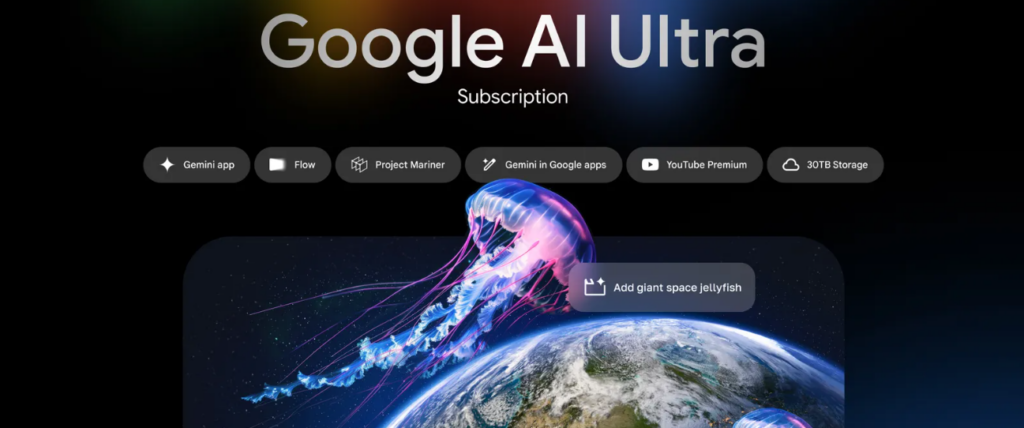
AI Ultra subscribers will be able to use Agent Mode for autonomous browsing, conducting research, analyzing sources, and performing tasks with integration into Gmail, Google Docs, Calendar, Drive, and other ecosystem services. In effect, Google is creating an AI layer on top of the browser, turning Chrome into a control center for the user’s digital activity.
Google emphasizes that the basic functions of Chrome will not change. The following will remain free:
- web browsing;
- working with tabs;
- installing and using extensions;
- synchronization of bookmarks and settings;
- standard security features.
Only advanced AI capabilities, which are currently in active development, will become paid. At the same time, Google has already applied a similar strategy: some Gemini features were initially available only to subscribers and then gradually became free.
This leaves room for maneuver – some agent functions may eventually be opened to a wider audience, but the most powerful scenarios are likely to remain in the premium segment.
Google is moving in line with the industry-wide trend of AI monetization. OpenAI offers ChatGPT Pro for $200 per month, Anthropic has launched Claude Max at a comparable price, and Microsoft is actively promoting Copilot as part of a subscription model.
The difference in Google’s strategy lies in the point of entry. Unlike standalone AI applications, Chrome is already installed on billions of users’ devices. This gives Google a unique advantage: built-in AI can become the default standard rather than an additional service.
In addition, Google enhances the value of subscriptions by adding related services – YouTube Premium, cloud storage, and access to experimental features.
According to Leopeva64, paid access to agent functions may be a temporary solution. Google traditionally tests new monetization models while observing the reaction of users and regulators.
At the moment, only preparatory infrastructure elements are visible in the Chromium code. Specific launch dates for agent functions in Chrome have not been officially announced, but the subscription architecture is already being laid out.
From the perspective of machine data analysis, Google’s actions reflect a fundamental shift in the understanding of the browser. It ceases to be just a program for viewing websites and becomes an operating environment for AI agents.
The history of technology markets shows that such transitions change the balance of power. Microsoft once lost the browser wars largely because it viewed Internet Explorer as an add-on to Windows rather than as an independent platform. Google, by contrast, is making Chrome the center of a new ecosystem, where AI is not a feature but the core.
From a macroeconomic perspective, a deeper question arises. The largest technology corporations simultaneously create demand for AI services and control their supply. Agent functions require access to user data, habits, and digital history at scales that create a high barrier to switching to alternative browsers.
In such a scenario, free Chrome can act as a “Trojan horse” – an outwardly open and free product inside which a new paid infrastructure of control and dependency is formed.
This will inevitably attract the attention of regulators, especially in the EU and the US, where investigations into the dominance of large platforms are already underway. The question is not whether AI functions will become paid, but who will control access to digital agents capable of acting on behalf of a human.
Conclusion:
Google is not making Chrome paid, but it is making the future of the browser paid. The transition to agent-based AI functions changes the very role of the browser – from a window to the internet to an intelligent intermediary between the user and the digital world.
In this model, it is not the program that becomes paid, but the ability to delegate actions to a machine. And it is precisely for this that users, apparently, will have to pay.
All content provided on this website (https://wildinwest.com/) -including attachments, links, or referenced materials — is for informative and entertainment purposes only and should not be considered as financial advice. Third-party materials remain the property of their respective owners.