

In 2025, the cocoa market became a clear example of how falling raw material prices do not necessarily translate into lower prices for the end consumer. Despite the fact that cocoa bean prices collapsed by more than 50% over the year, chocolate did not become cheaper in any country in the world. Bloomberg reports this, and the situation is far deeper than it may seem at first glance.
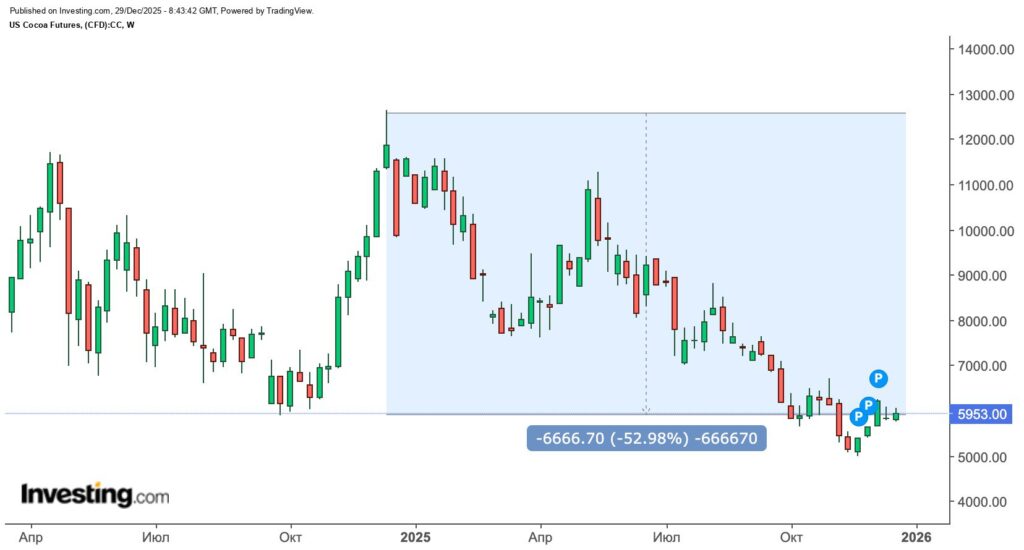
After an unprecedented surge in 2024, the cocoa market reversed by almost 180 degrees. At that time, cocoa futures nearly tripled, hitting the entire production chain – from processors to global chocolate brands. The price surge was driven by several factors at once: poor harvests in West Africa due to heavy rains and plant diseases, historically low global inventories, and an active inflow of speculative capital. At the peak, in late 2024, cocoa prices reached a record $12,565 per ton.
In 2025, the situation began to change rapidly. Weather conditions improved, supplies recovered, and the market started to price in a future oversupply. According to El Economista, by 2025 cocoa prices had fallen by 56.4% to around $5,090 per ton – the lowest level since early 2024. By the end of the year, cocoa could become one of the commodities with the sharpest price declines on global markets – nearly 60%.
However, this drop has not yet brought any benefit to consumers. Chocolate prices remain high and show no signs of decline. The reason is simple and quite mundane. Manufacturers are still processing cocoa beans purchased during the period of peak prices. The cost base of these batches is fixed, and lowering wholesale prices now would mean locking in losses.
In addition, over the past year companies have already restructured their pricing and product strategies. Chocolate became more expensive on store shelves, and the market effectively tested how much consumers are willing to pay. The result was predictable but not critical for producers: demand declined, but did not collapse. This sent a signal to companies that there is no need to rush prices back down.
Another important factor is changes in recipes. Many brands reduced the share of cocoa, decreased the weight of chocolate bars, or replaced some ingredients with cheaper plant-based or flavor substitutes. These changes were introduced as long-term cost-optimization measures and are not automatically reversed when raw material prices fall. Simply put, chocolate has become cheaper to produce but more expensive to sell, and this model suits manufacturers just fine.
On the supply side, the market is also undergoing structural changes. Although West Africa remains the key region, accounting for about 60% of global cocoa production, its dominance is gradually weakening. Improved weather conditions in Côte d’Ivoire and Ghana restored harvests, but at the same time the role of new players is growing.
Ecuador has been steadily strengthening its position in recent years and is effectively becoming one of the drivers of the recovery in global supply. Its consistent production growth offsets problems in other regions. In addition, production is expanding in Latin America and Indonesia, gradually reshaping the geography of the market.
According to RaboBank analysts, the market may face persistent surpluses in the coming years. In the 2025/2026 season, a surplus of around 380,000 tons is expected, and in 2026/2027 – up to 403,000 tons. Such excess supply traditionally puts pressure on prices and increases volatility, especially if financial speculators begin to exit the market en masse.
Nevertheless, even these forecasts do not imply an automatic decline in chocolate prices. Pricing in the food industry has long been detached from direct dependence on raw materials. Final prices reflect logistics, marketing, packaging, wages, inflation, and, most importantly, consumers’ willingness to pay. If the market has already accepted a higher price level, companies rarely abandon it voluntarily.
The conclusion looks cynical, but logical. The fall in cocoa prices has been a relief for producers and distributors, improving margins and reducing risks. For consumers, however, it is merely another confirmation of a simple rule: in the modern economy, lower production costs do not mean lower prices. Chocolate has become yet another example of how manufacturers use shocks in commodity markets to revise their pricing models in their own favor – and see no reason to return to previous levels.
All content provided on this website (https://wildinwest.com/) -including attachments, links, or referenced materials — is for informative and entertainment purposes only and should not be considered as financial advice. Third-party materials remain the property of their respective owners.