

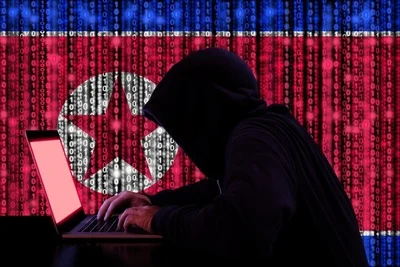
Chainalysis research marks an alarming milestone: since the beginning of the year, hackers have stolen cryptocurrencies worth $3.4 billion, surpassing the previous record of $3.3 billion in 2024. Formally, the difference seems small, but symbolically it is important — the market has not become safer as it matures; instead, it has faced a new wave of organized and high-tech attacks.
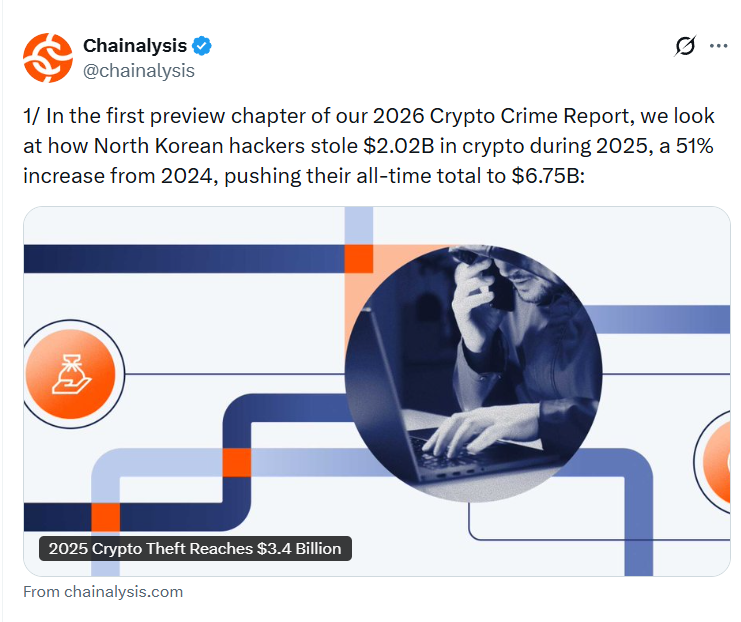
Special attention in the preliminary chapter of the Crypto Crime Report 2026 is given to the activities of North Korean hacker groups. According to Chainalysis, in 2025 alone they stole crypto assets worth $2.02 billion — 51% more than the previous year. The total volume of stolen funds linked to North Korea reached $6.75 billion over the observation period. This makes North Korea the largest state-sponsored crypto thief in history.
Crypto as an Element of State Economy
Unlike cybercriminals of past years acting for personal gain, North Korean groups are integrated into a state strategy. Stolen cryptocurrencies are used to finance defense programs, evade sanctions, and support the regime. Essentially, the crypto market has become an alternative export sector for Pyongyang — without ships, contracts, or customs.
Chainalysis notes that the attacks are highly planned. These are not random hacks, but multi-stage operations involving reconnaissance, social engineering, malware deployment, and subsequent laundering through complex on-chain chains.
Evolution of Attacks: Less Noise, More Efficiency
Previously, the largest thefts were linked to DeFi protocol and bridge hacks, but in 2025 the focus shifted. Increasingly important are attacks on infrastructure, developer wallets, exchange staff, and custodial services. The human factor remains the weakest link.
A notable feature of the current cycle is fewer attacks with higher average “checks.” Hackers steal less often but significantly more in a single operation. This indicates growing professionalization and access to better tools, including AI for phishing, fake video calls, and automated code analysis.
Money Laundering: Technology Race
Chainalysis emphasizes that a significant portion of stolen funds passes through mixers, cross-chain bridges, and decentralized exchanges. Law enforcement efficiency is improving, but not as fast as the sophistication of criminals. Every strengthening of control generates new bypass schemes — transaction splitting, use of little-known networks, stablecoins, and anonymous protocols.
Interestingly, some stolen funds remain “frozen” for years — hackers do not rush to convert them to fiat, waiting for more favorable conditions or reduced monitoring. Crypto is increasingly used as a strategic reserve, not just quick money.
Why Theft Records Are a Bad but Inevitable Sign
The increase in stolen funds does not necessarily indicate industry degradation. On the contrary, it reflects rising total market capitalization, inflow of institutional investors, and growing liquidity. Money goes where there is abundance. However, security develops unevenly: complex financial products appear faster than standards for their protection.
Particularly vulnerable are cross-chain bridges, custom smart contracts, and rapidly growing ecosystems where audits are treated as formalities rather than necessities.
Market Consequences
Chainalysis warns: further growth of crypto crime will inevitably increase regulatory pressure. For lawmakers, the $3.4 billion figure is not just a statistic, but an argument for stricter oversight. This implies more compliance, KYC, custodial solutions, and infrastructure requirements.

For investors and users, the takeaway is clear: the era of “be your own bank” without responsibility is over. Security becomes not an option, but a mandatory element of working with crypto assets. Hardware wallets, multi-factor protection, access separation, and conscious risk management are no longer paranoia, but basic hygiene.
Conclusion
The record $3.4 billion in stolen cryptocurrencies is not an anomaly but a reflection of market maturation. Crypto has ceased to be a toy and has become part of the global financial and geopolitical system. Where there is big money and states, there inevitably appear big crimes. The question now is not whether hacks will happen, but who will be ready for them — before regulators and hackers.
All content provided on this website (https://wildinwest.com/) -including attachments, links, or referenced materials — is for informative and entertainment purposes only and should not be considered as financial advice. Third-party materials remain the property of their respective owners.