


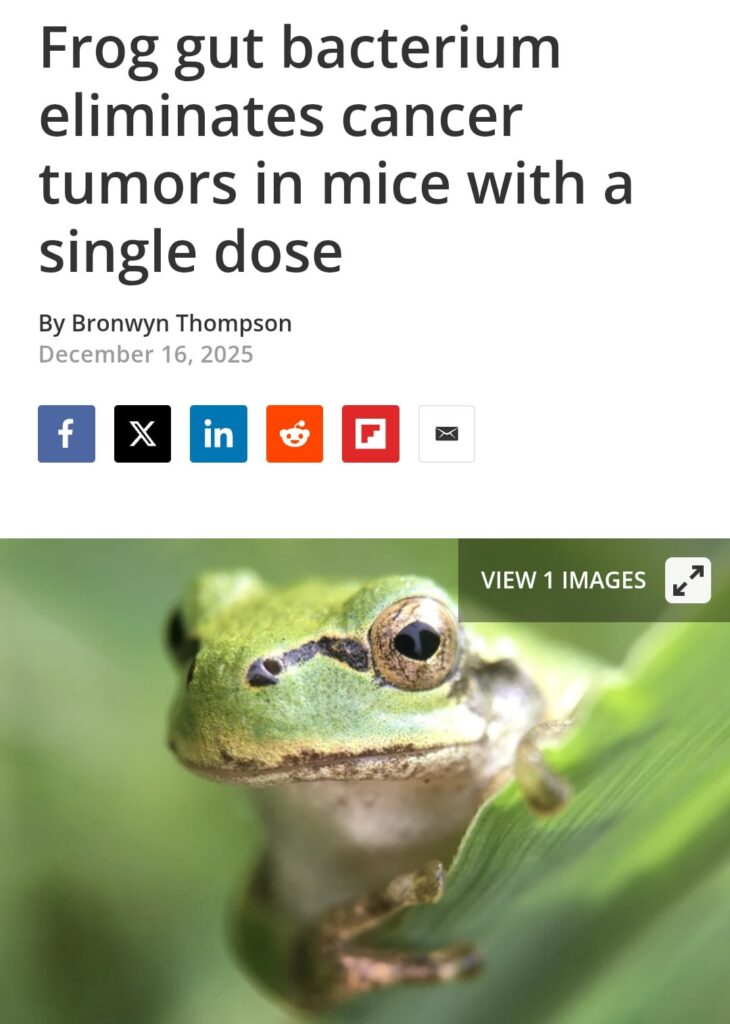
Scientists from the Japan Advanced Institute of Science and Technology (JAIST) have made a stunning discovery that could permanently change approaches to cancer treatment. In the bodies of common Japanese tree frogs, the bacterium Ewingella americana was discovered, capable of completely destroying malignant tumors. Laboratory studies in mice showed effectiveness significantly exceeding that of standard chemotherapy and modern immunotherapy methods.
- The bacterium Ewingella americana was found in the intestines of the Japanese tree frog and has the ability to independently move through the body, locate tumors, and destroy them without causing relapses.
- In experiments on mice, a single injection of the bacterium completely eliminated tumors – the result was 100% successful treatment.
- E. americana has been recognized as safe: it does not damage healthy organs or tissues.
- Tumors died just three days after the introduction of the bacterium, which, according to researchers, is safer and more effective than chemotherapy and immunotherapy.
The team is currently preparing clinical trials in humans, and if successful, this could become a real breakthrough in medical practice.
Why Did Researchers Focus on Frogs?
Scientists studied the gut microbiome of amphibians and reptiles for several reasons. First, spontaneous tumors occur extremely rarely in these animals. Cancer almost always arises due to external factors: environmental pollution or laboratory conditions.
Second, amphibians and some reptiles live relatively long for their size, withstand extreme cellular loads (metamorphosis, regeneration of body parts), and inhabit environments rich in pathogens. All of this should have increased the risk of cancer, but the opposite effect is observed.
Researchers suggested that part of the protection against cancer comes not only from the animals’ own cells but also from the microorganisms inhabiting their intestines.
From 45 Strains to One Winner
Scientists isolated 45 bacterial strains from three species of amphibians and reptiles:
- Japanese tree frogs
- Japanese fire-bellied newts (Cynops pyrrhogaster)
- apanese grass lizards (Takydromus tachydromoides)
After intensive screening, the list was reduced to nine microbes with antitumor activity. Ewingella americana stood out in particular, showing the highest effectiveness.
Mechanism of Action of Ewingella americana
The bacterium acts through a dual mechanism: .
- Direct destruction of cancer cells E. americana naturally targets low-oxygen environments – conditions that prevail inside tumors. Within 24 hours, the number of bacteria in the tumor increases 3000-fold, remaining strictly within tumor tissue. The bacterium releases toxins that kill cancer cells
- Activation of the immune system
Bacterial invasion stimulates a natural immune response: the tumor becomes filled with neutrophils, T and B cells, and levels of inflammatory signaling molecules increase. As a result, tumor destruction occurs both through the direct action of the bacterium and through the body’s own immune system.
Mouse Experiment: 100% Effectiveness
Mice with colorectal cancer were given a single injection of E. americana. Tumors completely disappeared in all animals. Upon reintroduction of cancer cells, none of the animals developed a new tumor, indicating the formation of long-term immune memory. Thus, one injection provided both treatment and prevention.
Comparison with Standard Therapy Methods
E. americana showed significantly higher effectiveness compared to:
- anti-PD-L1 antibodies (modern immunotherapy)
- doxorubicin (classical chemotherapy)
At the same time, the bacterium is quickly eliminated from the body and causes only short-term inflammatory reactions that disappear within 72 hours.
Safety and Antibiotic Sensitivity
The bacterium is sensitive to antibiotics, providing additional control in case of complications. Researchers note minimal pathogenicity of the strain and the absence of chronic toxicity at therapeutically effective doses.
Hope for Patients
“The successful identification of E. americana as a powerful natural antitumor agent establishes proof of concept for bacterial therapies and lays the foundation for a new class of cancer treatments,” the scientists concluded.
Although a long path remains before clinically approved treatments for humans, the discovery provides new hope to millions of patients with resistant forms of cancer.
Against the Background of Old Threats
While science moves forward, old diseases are returning: syphilis, long considered virtually eradicated, is once again increasing in incidence. Scientists remind of the importance of careful monitoring and prevention.
All content provided on this website (https://wildinwest.com/) -including attachments, links, or referenced materials — is for informative and entertainment purposes only and should not be considered as financial advice. Third-party materials remain the property of their respective owners.