

The French banking group BPCE, the second-largest financial institution in the country with approximately €1.3 trillion in assets under management, is officially launching cryptocurrency trading directly inside its banking apps. The service starts with the ability to buy and sell Bitcoin, Ethereum, Solana, and the stablecoin USDC, and will first become available to two million clients of Banque Populaire and Caisse d’Epargne. Europe is entering a new phase of large-scale banking crypto-integration.
By 2026, digital asset trading will be connected to the entire BPCE network — that is already 12 million users. For Europe, this is one of the largest projects integrating crypto trading into the traditional banking environment.
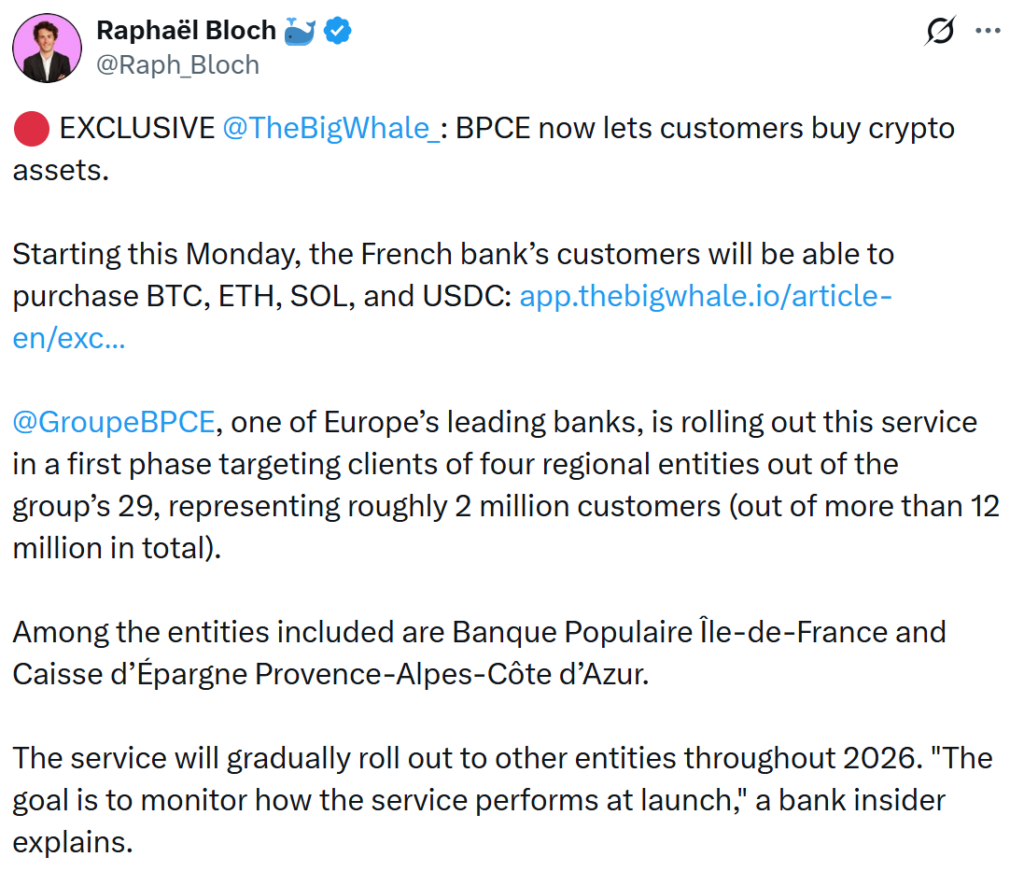
Source: X network
A new stage: crypto becomes part of classical banking
BPCE’s development makes the group one of the first major European banks to integrate digital assets into its basic product line. This is not a peripheral experiment — it is a strategic direction as the bank enters competition with fintech giants that have long offered crypto trading in their apps: Revolut, Trade Republic, Bitstack, deBlock, and others.
At the initial stage, the service is being launched in four regional banks, including Banque Populaire Île-de-France and Caisse d’Épargne Provence-Alpes-Côte d’Azur. The gradual rollout will allow BPCE to test load, user interest, and operational stability before expanding nationwide.
How crypto trading will work at BPCE
Buying and selling digital assets will occur through a special crypto account built directly into the banking app. The operational component is handled by the bank’s own crypto subsidiary — Hexard, ensuring that BPCE retains full control without outsourcing to third parties.
Service fees:
- transaction fee: 1.5%
- minimum fee: $1.16
- monthly crypto account fee: $3.48 (2.99 euros)
External exchanges, separate wallets, and complex registration procedures are no longer needed — everything works inside the bank’s infrastructure with its familiar interface logic and traditional banking security.
Europe accelerates crypto-service integration
BPCE’s launch fits into a broader trend: European financial institutions are actively moving crypto from the category of “experimental” to “fully recognized financial instrument.”
Examples:
- BBVA already allows Spanish clients to buy and store Bitcoin and Ethereum inside the app, providing full custodial support.
- Openbank (Santander) has opened access to five digital assets, integrating crypto operations with traditional investment products.
- Raiffeisen Bank (Austria) partnered with Bitpanda and now offers clients access to cryptocurrencies directly from the banking dashboard.
Mass adoption not only increases competition but also prepares the European market for the MiCA era — the unified EU crypto-assets regulation that makes operations transparent and standardized across Europe.
France strengthens control: crypto included in new wealth tax
Amid growing banking integration, the French government has decided to include cryptocurrencies in the list of non-productive assets subject to the new wealth tax. Owners of digital assets worth more than $2.3 million will pay 1% tax.
Amid growing banking integration, the French government has decided to include cryptocurrencies in the list of non-productive assets subject to the new wealth tax. Owners of digital assets worth more than $2.3 million will pay 1% tax.
The decision sparked criticism. Ledger co-founder Éric Larchevêque noted that the new rule essentially punishes people who use Bitcoin and gold as stores of value. In some cases, investors may even need to sell assets to cover tax obligations.

Final adoption of the amendment is expected during the 2026 budget process.
Why BPCE’s step matters
Launching crypto trading inside one of the largest banks is a sign that digital assets are no longer an “alternative” — they are quickly becoming part of everyday financial services.
Previously, access to cryptocurrencies required specialized exchanges, separate apps, registration on external platforms, and understanding technical specifics. Now crypto is becoming a basic option, like investing in funds or managing a savings account.
BPCE is becoming one of the pioneers among systemically important European banks, paving the way toward a moment when cryptocurrency will no longer be a niche tool but a standard component of banking products.
Bottom line:
France is taking a decisive step toward the crypto economy. BPCE is launching one of the largest projects in Europe to integrate cryptocurrencies into a traditional banking application. This strengthens crypto’s position within the financial system and pushes other market players to accelerate the rollout of similar services.
A world where cryptocurrency is an ordinary banking function is getting closer.
Here, by the way, you can buy the legendary beginner-friendly hardware wallets with all basic features!
All content provided on this website (https://wildinwest.com/) -including attachments, links, or referenced materials — is for informative and entertainment purposes only and should not be considered as financial advice. Third-party materials remain the property of their respective owners.