

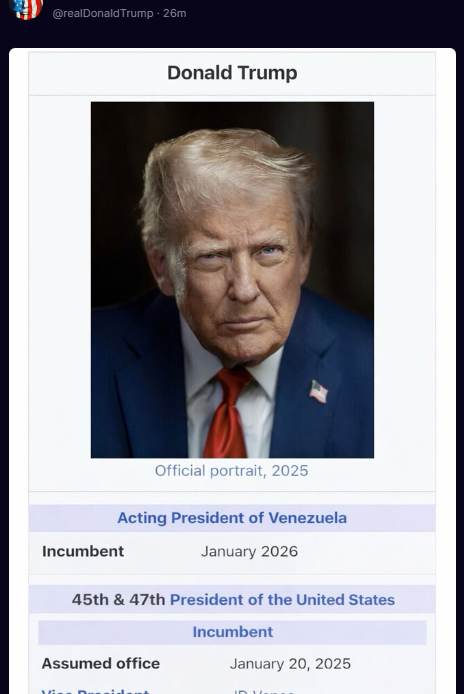
The beginning of 2026 increasingly resembles a political and financial thriller, where each morning the market wakes up to a new source of uncertainty. This time, the main catalyst has been Donald Trump, who, in his usual manner, decided to sharply raise the stakes on several fronts at once.
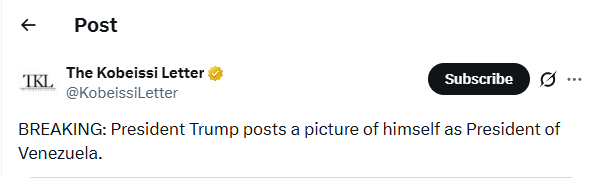
Trump publicly declared himself acting president of Venezuela. Formally, this looks like a political gesture; in practice, it is a demonstrative challenge to the existing international order. At the same time, he escalated his rhetoric toward Iran, Cuba, and even Denmark, which in itself sounds absurd, but markets, as always, do not understand jokes. For investors, this is not a set of eccentric statements, but an increase in geopolitical risks that are immediately priced into safe-haven assets.
The reaction was swift and telling. During overnight trading, gold nearly reached the level of $4,600 per ounce, while silver surged to $84. This is not just a news-driven rally; it is a classic flight to safety. When the political agenda becomes chaotic, capital seeks not returns, but survival. And in such moments, gold is once again remembered as the ultimate asset without an issuer, promises, or political conditions.
Against this backdrop, another conflict flared up, this time within the United States itself. The Department of Justice served the Federal Reserve with a subpoena related to a possible misappropriation of funds during the renovation of the Fed’s main building, connected to Jerome Powell’s office. Formally, the case concerns budget discipline and a review of expenditures, but in substance it looks like a direct attack on the regulator’s independence. Potentially, the case could escalate into criminal proceedings, an unprecedented situation for the head of the Federal Reserve.
Powell’s response was extremely firm. He stated outright that the root cause of the situation is Trump’s personal dissatisfaction with tight monetary policy and the Fed’s refusal to bend to the political wishes of the White House. Powell made it clear that the regulator does not intend to yield, even if pressure intensifies. For markets, this is an alarming signal. Central bank independence is one of the cornerstones of US financial stability. Any doubts about it automatically increase the risk premium for the dollar, bonds, and the stock market.
Against this backdrop, the crypto market attempted a cautious move higher, but without much enthusiasm. Geopolitical turbulence and an open conflict between Trump and the Fed create too many unknowns. In such conditions, speculative capital is in no hurry to build positions, preferring to wait for clearer signals. At the same time, buyers are trying to maintain a positive tone, as an extremely busy and potentially decisive week lies ahead.

On January 13, the market will receive US inflation data, which could either confirm the need for a tight Fed policy or provide grounds for a new wave of pressure on the regulator. On January 14, the US Supreme Court will issue a ruling on tariffs, directly affecting trade wars and global supply chains. On January 15, the Senate will consider the CLARITY bill, which is important for crypto market regulation and could set the direction for the entire industry for years to come.
As a result, a picture is emerging in which politics, monetary authority, and markets are becoming increasingly intertwined. Trump continues to act through shock and pressure, the Fed shows its readiness to defend its autonomy, and investors are forced to navigate between inflation, geopolitics, and regulatory risks. The rise in gold and silver in such an environment looks not like speculation, but like a symptom. The market is voting not for optimism, but for protection. And as long as this logic dominates, volatility will remain the defining backdrop of 2026.
All content provided on this website (https://wildinwest.com/) -including attachments, links, or referenced materials — is for informative and entertainment purposes only and should not be considered as financial advice. Third-party materials remain the property of their respective owners.